
Manchester vs. Differential Manchester Encoding: A Comparison
By RF Wireless Expert Team
Advertisement
This article compares Manchester and Differential Manchester encoding, highlighting the differences between them and discussing their respective advantages and disadvantages.
Introduction:
Line coding techniques are used to convert data elements into signal elements. These include:
- Unipolar (NRZ)
- Polar (NRZ, RZ, Biphase)
- Bipolar (AMI, Pseudoternary)
- Multilevel (2B1Q, 8B6T, 4D-PAM5)
- Multitransition (MLT-3)
Biphase line coding includes Manchester and Differential Manchester encoding.
For a comparison of Unipolar, Polar, and Bipolar coding, refer to the dedicated article.
Manchester Encoding
- A transition occurs in the middle of each bit period.
- This transition serves as both a clock edge and a data mapping mechanism.
- Low to High transition represents a ‘1’
- High to Low transition represents a ‘0’
- Used by the IEEE 802.3 specification for Ethernet LANs (short distances).
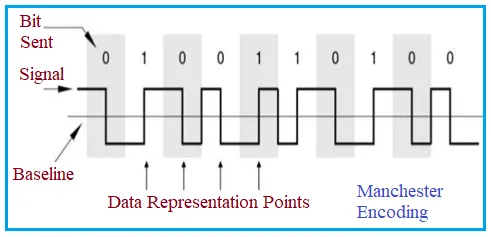 Manchester Encoding
Differential Manchester Encoding
- A dedicated mid-bit transition is used only for clocking purposes.
- Data representation is determined at the beginning of each bit period.
- No transition at the start of a bit period represents a ‘1’.
- A transition at the start of a bit period represents a ‘0’ (inverts on 0s - opposite of NRZI).
- Example: Differential encoding.
- Used by the IEEE 802.5 specification for Token Ring LANs.
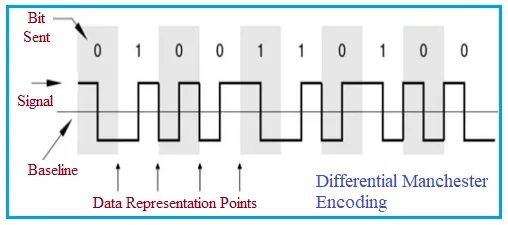 Differential Manchester Encoding
Advantages of Manchester and Differential Manchester (Biphase) Encoding
Both Manchester and Differential Manchester fall under the Biphase encoding category. Here are some advantages:
- Synchronization: Guaranteed mid-bit transitions provide inherent synchronization capabilities at the receiver. These are self-clocking codes.
- No DC Component: Being bipolar signals, they ideally have no DC components.
- Error Detection: The absence of expected transitions can be detected, providing a mechanism for error detection.
Disadvantages of Biphase Encoding
- Bandwidth: Requires at least one transition per bit time (potentially two). The modulation or signal rate is two times that of NRZ, thus requiring more bandwidth.
- Distance: Typically used over shorter distances, such as in LANs.
Continue Learning Forward Error Correction (FEC) & Channel Coding
- Forward Error Correction: Advantages & Disadvantages
- Convolutional Encoder Example
- Turbo Encoder Basics
- CIRC Encoding vs Decoding
- Differential Encoder/Decoder Explained
Explore AI & Audio Coders
- Rotary Encoder: Basics and Types
- Understanding Vocoding and Vocoders
- Autoencoder Function in 6G Networks
Explore Data Encoding Techniques
- Encoding vs Modulation: Understanding the Difference
- Manchester vs Differential Manchester Encoding
- 4B/5B Encoding: Advantages & Disadvantages
- 8B/10B Encoding: Advantages & Disadvantages
- 64B/66B vs 8B/10B Encoding Comparison
- HDB3 Encoding: Advantages & Disadvantages
- MLT-3 Encoding: Advantages & Disadvantages
- R8ZS Encoding: Advantages & Disadvantages
- RZ, NRZ, CRZ, CSRZ Line Encoding Comparison