
What is RZ Line Coding: 5 Advantages and Disadvantages
Advertisement
RZ (Return-to-Zero) line coding is a digital encoding technique in which the signal returns to zero voltage during every bit interval to improve synchronization. Its advantages include easier clock recovery and reduced timing errors, whereas its disadvantages include higher bandwidth requirements and lower transmission efficiency compared to NRZ coding.
Introduction : Digital signals are sequences of discrete voltage pulses. Various encoding techniques, such as NRZ, RZ, and biphase, are used to map data bits.
RZ Encoding Procedure
In RZ encoding, binary data is represented by pulses that have a transition, rather than maintaining a constant voltage level. The transition in RZ occurs precisely at the center of the bit period, hence the name ‘Return to Zero’. Unipolar, polar, and bipolar signaling rules can be applied before encoding the binary data using RZ.
Unipolar RZ encoding process
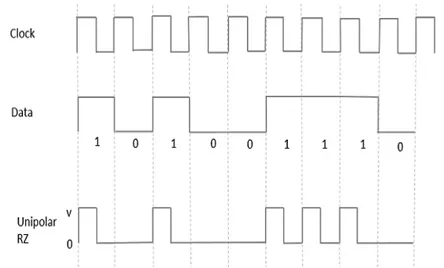
Using unipolar RZ encoding, a binary ‘1’ is mapped to a positive pulse with amplitude ‘V’ for half the bit period and then returns to zero for the next half. A binary ‘0’ is represented by the absence of a pulse for the entire bit period.
Example of Unipolar RZ encoding:
- INPUT: [1 0 1 0 0 1 1 1 0]
- Bit period: Tb
- OUTPUT: [+ve pulse (over Tb/2 time duration) DC (Tb/2), DC (over Tb duration), +ve pulse (Tb/2) DC (Tb/2), DC (Tb) , DC (Tb), +ve pulse (Tb/2) DC (Tb/2) , +ve pulse (Tb/2) DC (Tb/2) , +ve pulse (Tb/2) DC (Tb/2) , DC (Tb) ]
Polar RZ encoding process
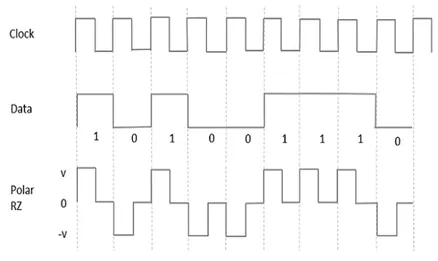
In polar RZ encoding, a binary ‘1’ is mapped to a positive pulse with amplitude ‘V’ in the first half of the bit period and returns to zero in the second half. A binary ‘0’ is mapped to a negative pulse with amplitude ‘V’ in the first half of the bit period and returns to zero in the next half.
Example of Polar RZ coding:
- INPUT: [1 0 1 0 0 1 1 1 0]
- OUTPUT: [+ve pulse (Tb/2) DC (Tb/2), -ve pulse (Tb/2) DC (Tb/2), +ve pulse (Tb/2) DC (Tb/2) , -ve pulse (Tb/2) DC (Tb/2), -ve pulse (Tb/2) DC (Tb/2), +ve pulse (Tb/2) DC (Tb/2), +ve pulse (Tb/2) DC (Tb/2), +ve pulse (Tb/2) DC(Tb/2), -ve pulse(Tb/2) DC (Tb/2) ]
Bipolar RZ
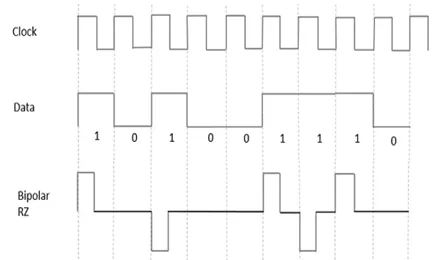
In bipolar RZ encoding, a binary ‘1’ is mapped to a positive or negative pulse of amplitude ‘V’ based on its alternating position during the first half of the bit period. The polarity alternates for consecutive 1s. The signal remains at zero DC level for the next half-bit period. A binary ‘0’ is mapped to the absence of a pulse for the entire bit period.
Example of Bipolar RZ line coding:
- INPUT: [1 0 1 0 0 1 1 1 0]
- OUTPUT: [+ve pulse (over ‘Tb/2’) DC (‘Tb/2’), DC (over ‘Tb’), -ve pulse (‘Tb/2’) DC (‘Tb/2’), DC (‘Tb’), DC (‘Tb’), +ve pulse (‘Tb/2’) DC (‘Tb/2’) , -ve pulse (‘Tb/2’) DC (‘Tb/2’) , +ve pulse (‘Tb/2’) DC (‘Tb/2’), DC (‘Tb’)]
Benefits or Advantages of RZ Encoding
- It is a simple line coding technique.
- In polar RZ and bipolar RZ, there are no low-frequency components.
- Bipolar NRZ/RZ signaling waveforms occupy lower bandwidth than unipolar NRZ and polar NRZ waveforms.
- Signal drooping does not occur in Bipolar coding, making it suitable for data transmission over AC-coupled lines.
- Single error detection is possible with this line coding technique.
Drawbacks or Disadvantages of RZ Line Coding
- Signal droop occurs when the signal is non-zero at 0 Hertz.
- Unipolar/Polar RZ occupies twice the bandwidth compared to Unipolar/polar NRZ, respectively.
- No error correction capability.
- No inherent clock signal is available.
- Loss of synchronization can occur due to long strings of ones and zeros in the binary data.
Summary
RZ line coding improves synchronization and timing accuracy in digital communication systems by ensuring frequent signal transitions during transmission. Its encoding advantages enhance reliable data recovery, although increased bandwidth consumption and reduced spectral efficiency limit its use in modern high speed communication networks.
Continue Learning Forward Error Correction (FEC) & Channel Coding
- Forward Error Correction: Advantages & Disadvantages
- Convolutional Encoder Example
- Turbo Encoder Basics
- CIRC Encoding vs Decoding
- Differential Encoder/Decoder Explained
Explore AI & Audio Coders
- Rotary Encoder: Basics and Types
- Understanding Vocoding and Vocoders
- Autoencoder Function in 6G Networks
Explore Data Encoding Techniques
- Encoding vs Modulation: Understanding the Difference
- Manchester vs Differential Manchester Encoding
- 4B/5B Encoding: Advantages & Disadvantages
- 8B/10B Encoding: Advantages & Disadvantages
- 64B/66B vs 8B/10B Encoding Comparison
- HDB3 Encoding: Advantages & Disadvantages
- MLT-3 Encoding: Advantages & Disadvantages
- R8ZS Encoding: Advantages & Disadvantages
- RZ, NRZ, CRZ, CSRZ Line Encoding Comparison