
What is R8ZS Encoding: 5 Advantages and Disadvantages
Advertisement
R8ZS (Bipolar with 8-Zero Substitution) encoding is a bipolar line coding technique that replaces long sequences of eight consecutive zeros with predefined bipolar violation patterns to maintain synchronization in digital communication systems. Its advantages include reliable clock recovery and improved transmission integrity, while its disadvantages include higher implementation complexity and limited use in modern high speed networking standards.
R8ZS Encoding Procedure with example
R8ZS (also known as “Modified AMI Code”) is a scrambling technique designed to prevent long sequences of zeros in a data stream. It works by replacing any string of eight consecutive zeros with the sequence “000VB0VB”.
- V (Violation): Represents a non-zero voltage that violates the standard AMI (Alternate Mark Inversion) encoding rule. Its polarity is opposite to the polarity of the previous ‘1’ bit.
- B (Bipolar): Indicates a non-zero level voltage, following the AMI rule (alternating polarity for ‘1’ bits).
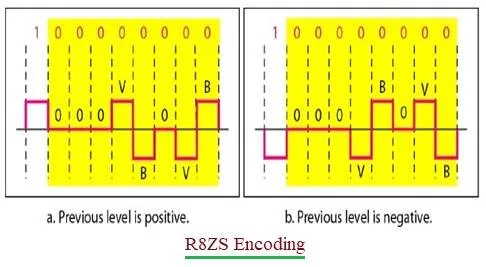 Image alt: R8ZS scrambling
Example #1: Previous level is positive (+ve voltage or ‘1’)
- Input: [ 0 0 0 0 0 0 0 0 ]
- Output: [0 0 0 +ve -ve 0 -ve +ve] (following the “000VB0VB” rule)
Example #2: Previous level is negative (-ve voltage or ‘1’)
- Input: [ 0 0 0 0 0 0 0 0 ]
- Output: [0 0 0 -ve +ve 0 +ve -ve] (following the “000VB0VB” rule)
Benefits or Advantages of R8ZS Encoding
- No Bit Rate Increase: Unlike some block coding schemes, R8ZS doesn’t add extra bits to the data, so it doesn’t increase the bit rate. This is a significant advantage in bandwidth-constrained environments.
- Improved Synchronization: By eliminating long strings of zeros, R8ZS ensures frequent signal transitions. These transitions are crucial for maintaining synchronization between the transmitter and receiver.
- DC Balance: The encoding process maintains DC balance by carefully balancing positive and negative voltage levels. This is important for preventing signal distortion and ensuring reliable transmission.
- Compatibility with Bipolar AMI: Bipolar AMI encoding has a narrow bandwidth and avoids introducing a DC component. R8ZS complements this by removing long sequences of 0s. This combination makes Bipolar AMI with R8ZS suitable for long-distance communication.
- Built-in Error Detection: The AMI violation introduced by the ‘V’ bits allows for simple error detection at the receiver. If an AMI violation is detected where it shouldn’t be, it indicates a possible error.
Drawbacks or Disadvantages of R8ZS Encoding
- Sensitivity to Single Bit Errors: A single bit error at the R8ZS decoder input can lead to errors in the descrambled data.
- Error Propagation: If the decoder isn’t properly reset after an error, it can lead to significant error propagation, corrupting subsequent data.
Summary
R8ZS encoding enhances digital data transmission by preventing synchronization loss caused by long zero sequences, making communication links more dependable and efficient. Although its benefits include improved timing recovery and signal reliability, its limitations and declining adoption in newer communication systems restrict its use primarily to specialized telecommunications applications.
Continue Learning Forward Error Correction (FEC) & Channel Coding
- Forward Error Correction: Advantages & Disadvantages
- Convolutional Encoder Example
- Turbo Encoder Basics
- CIRC Encoding vs Decoding
- Differential Encoder/Decoder Explained
Explore AI & Audio Coders
- Rotary Encoder: Basics and Types
- Understanding Vocoding and Vocoders
- Autoencoder Function in 6G Networks
Explore Data Encoding Techniques
- Encoding vs Modulation: Understanding the Difference
- Manchester vs Differential Manchester Encoding
- 4B/5B Encoding: Advantages & Disadvantages
- 8B/10B Encoding: Advantages & Disadvantages
- 64B/66B vs 8B/10B Encoding Comparison
- HDB3 Encoding: Advantages & Disadvantages
- MLT-3 Encoding: Advantages & Disadvantages
- RZ, NRZ, CRZ, CSRZ Line Encoding Comparison