
What is Forward Error Correction : FEC Advantages and Disadvantages
By RF Wireless Expert Team
Advertisement
Forward Error Correction (FEC) is a communication technique that adds redundant data to transmitted information, enabling receivers to detect and correct errors without retransmission. It is widely used in wireless, satellite, optical, and storage systems. Advantages include improved reliability and reduced retransmissions, while disadvantages include increased bandwidth overhead and processing complexity.
Functions & Examples of Forward Error Correction (FEC)
- FEC is a method employed to control errors during data transmission.
- The sender incorporates extra, redundant data into the messages – this is the error correction code.
- The receiver then uses this redundant information to fix any errors that may have occurred during transmission.
- Here are a few examples of FEC techniques used in transmitters and receivers:
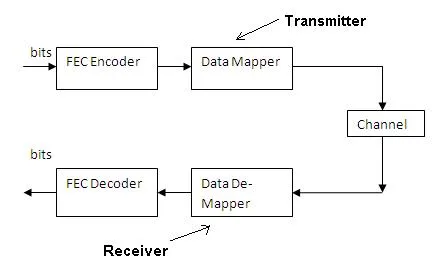
- Example #1: Convolution encoder on the transmitting end, and a Viterbi decoder on the receiving end.
- Example #2: CTC encoder on the transmitting end, and a CTC decoder on the receiving end.
- Example #3: LDPC encoder on the transmitting end, and an LDPC decoder on the receiving end.
Advantages of Forward Error Correction (FEC)
- High Fault Tolerance: FEC significantly improves fault tolerance, leading to a decreased Bit Error Rate (BER).
- No Back Channel Needed: Because FEC can correct errors on its own, there’s no need for a return channel to request retransmissions (avoiding ARQ).
- Simple Implementation: FEC can be put in place using straightforward logic.
- Cost-Effective: It’s a budget-friendly approach, often starting with software implementations before moving to hardware.
- Fast Results: Thanks to its algorithms, FEC delivers quick error detection and correction.
- Real-Time Error Handling: FEC codes can operate in real-time to both detect and correct errors as they happen.
Disadvantages of Forward Error Correction (FEC)
- Data Redundancy: It increases data redundancy, which can affect overall data throughput.
- Bandwidth Inefficiency: While power-efficient, the extra data overhead makes it less bandwidth-efficient.
Summary
FEC improves communication reliability by correcting transmission errors at the receiver. Advantages include enhanced data integrity and lower retransmission needs, while disadvantages include additional bandwidth and computational requirements.
Continue Learning Forward Error Correction (FEC) & Channel Coding
- Forward Error Correction
- Convolutional Encoder Example
- Turbo Encoder Basics
- CIRC Encoding vs Decoding
- Differential Encoder/Decoder Explained