
What is MLT-3 Encoding : Advantages and Disadvantages
Advertisement
MLT-3 (Multi-Level Transmit-3) is a line coding scheme that uses three voltage levels to transmit digital data while reducing signal bandwidth requirements. It is commonly used in Fast Ethernet systems. Advantages include lower electromagnetic emissions and bandwidth efficiency, while disadvantages include increased encoding complexity and limited noise immunity.
MLT-3 Encoding (Multiline Transmission) Procedure
MLT-3 encoding utilizes three voltage levels (+V, 0, -V) and specific transition rules to switch between these levels. It shares similarities with NRZ-I (Non-Return-to-Zero Inverted). The following rules are applied when encoding a bit pattern, as demonstrated in the example below:
- If the next bit is zero (‘0’), there is no transition in the signal level.
- If the next bit is one (‘1’) and the current level is not zero (‘0’), the next level is 0.
- If the next bit is one (‘1’) and the current level is zero (‘0’), the next level is the opposite of the last nonzero level.
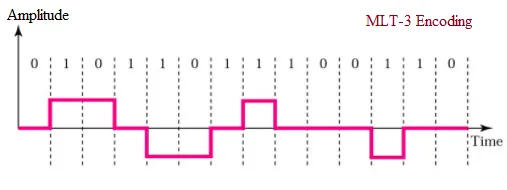 MLT-3 encoding
The encoding, based on the rules above, is illustrated in the figure. While similar to NRZ-I, MLT-3’s encoding provides a signal shape that effectively reduces the required bandwidth.
Let’s examine this with an example of a long sequence of ones (‘1s’).
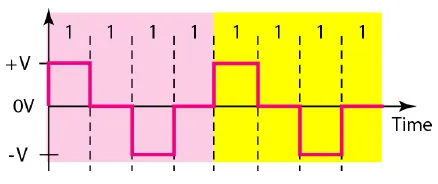 MLT-3 worst case scenario
In this example, the signal pattern (+V 0 -V 0) repeats every 4 bits. It’s evident that MLT-3 converts a non-periodic signal into a periodic signal with a period equal to four times the bit duration. MLT-3 is useful for transmitting 100 Mbps on copper wires that cannot support frequencies greater than 32 MHz.
Benefits or Advantages of MLT-3 Encoding
- It has a signal rate that is (1/4)th of the bit rate.
- Its signal shape reduces the required bandwidth.
Drawbacks or Disadvantages of MLT-3 Encoding
- It does not support self-synchronization for long strings of zeros (‘0’).
- It is more complex than NRZ-I due to the use of three levels and complex transition rules.
Summary
MLT-3 encoding reduces transmission bandwidth by cycling through three signal levels. Advantages include lower EMI and efficient spectrum usage, while disadvantages include reduced robustness and more complex implementation.
Continue Learning Forward Error Correction (FEC) & Channel Coding
- Forward Error Correction: Advantages & Disadvantages
- Convolutional Encoder Example
- Turbo Encoder Basics
- CIRC Encoding vs Decoding
- Differential Encoder/Decoder Explained
Explore AI & Audio Coders
- Rotary Encoder: Basics and Types
- Understanding Vocoding and Vocoders
- Autoencoder Function in 6G Networks
Explore Data Encoding Techniques
- Encoding vs Modulation: Understanding the Difference
- Manchester vs Differential Manchester Encoding
- 4B/5B Encoding: Advantages & Disadvantages
- 8B/10B Encoding: Advantages & Disadvantages
- 64B/66B vs 8B/10B Encoding Comparison
- HDB3 Encoding: Advantages & Disadvantages
- R8ZS Encoding: Advantages & Disadvantages
- RZ, NRZ, CRZ, CSRZ Line Encoding Comparison