
What is HDB3 Encoding: Advantages and Disadvantages
Advertisement
High Density Bipolar 3 Zeros (HDB3) is a line coding technique used in digital telecommunications to maintain synchronization and eliminate long sequences of zeros. It is commonly used in E-carrier systems. Advantages include reliable clock recovery and DC balance, while disadvantages include encoding complexity and additional processing overhead.
HDB3 Encoding Procedure
HDB3, which stands for High Density Bipolar 3 Zeros, is a scrambling technique based on Bipolar AMI (Alternate Mark Inversion). It’s commonly used in E1 telecommunications. Similar to R8ZS, it helps maintain data rate and provide synchronization during data communication.
In HDB3, sequences of four consecutive zero-level voltages are replaced by either “000V” or “B00V”, where ‘B’ represents a bipolar pulse and ‘V’ represents a violation pulse. These substitutions are strategically employed to ensure an even number of non-zero pulses.
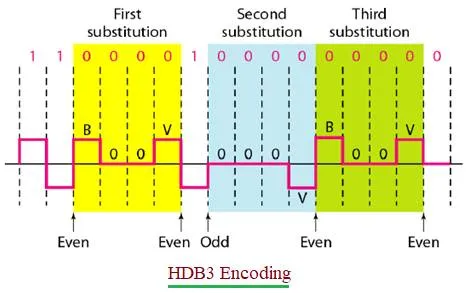
The encoding follows these two principal rules:
- Odd Non-Zero Pulse Count: If the number of non-zero pulses after the last substitution is odd, the substitution pattern “000V” is used. This ensures the total number of non-zero pulses becomes even.
- Even Non-Zero Pulse Count: If the number of non-zero pulses after the last substitution is already even, the substitution pattern “B00V” is used. This maintains the even number of non-zero pulses.
Benefits or Advantages of HDB3 Encoding
Here are the key benefits and advantages of using HDB3 encoding:
- Synchronization: HDB3 replaces long sequences of zero-level pulses with combinations of other levels, providing necessary synchronization.
- No DC Component: The encoded signal doesn’t have any DC components, which is beneficial for transmission systems.
- Data Rate Preservation: It maintains the total number of bits at the input and output, preventing any increase or decrease in the data rate.
- Error Detection: HDB3 offers built-in error detection capabilities. The presence of ‘V’ pulses where they are not expected signals an error.
- Energy Concentration: Most of the signal energy is concentrated around a frequency equal to half the data rate, which is desirable for efficient transmission.
- Suitable for Long Distances: It’s suitable for high data rate transmission over long distances.
Drawbacks or Disadvantages of HDB3 Encoding
Despite its advantages, HDB3 encoding also has some drawbacks:
- Single Bit Error Propagation: Like R8ZS, a single bit error at the decoder input can lead to an error in the descrambled data output.
- Error Propagation with Resetting Issues: If the registers are not properly reset at the start of the descrambling process, it can result in significant error propagation throughout the data.
Summary
HDB3 encoding improves digital signal transmission by preventing long zero sequences. Advantages include synchronization reliability and DC balance, while disadvantages include increased coding complexity.
Continue Learning Forward Error Correction (FEC) & Channel Coding
- Forward Error Correction: Advantages & Disadvantages
- Convolutional Encoder Example
- Turbo Encoder Basics
- CIRC Encoding vs Decoding
- Differential Encoder/Decoder Explained
Explore AI & Audio Coders
- Rotary Encoder: Basics and Types
- Understanding Vocoding and Vocoders
- Autoencoder Function in 6G Networks
Explore Data Encoding Techniques
- Encoding vs Modulation: Understanding the Difference
- Manchester vs Differential Manchester Encoding
- 4B/5B Encoding: Advantages & Disadvantages
- 8B/10B Encoding: Advantages & Disadvantages
- 64B/66B vs 8B/10B Encoding Comparison
- MLT-3 Encoding: Advantages & Disadvantages
- R8ZS Encoding: Advantages & Disadvantages
- RZ, NRZ, CRZ, CSRZ Line Encoding Comparison