
Turbo Encoder Basics: Convolutional Turbo Codes Explained
Advertisement
This page covers Convolutional Turbo Code (CTC) encoder basics with a rate 1/3 example, a Forward Error Correction (FEC) technique. Turbo code is a popular FEC technique used in next-generation wireless communication systems such as Mobile WiMAX and LTE.
Let’s explore the CTC technique. The figure below depicts a rate 1/3 CTC encoder used in Mobile WiMAX (IEEE 802.16e) OFDMA physical layer.
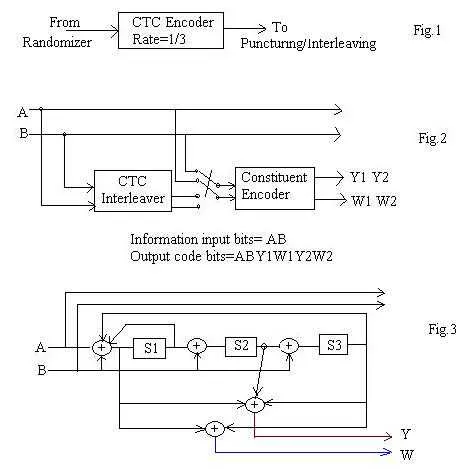
As shown in Figure 1, the CTC encoder is placed between the randomizer and the puncturing/interleaving stages. The CTC encoder itself is composed of a CTC interleaver and a constituent encoder, as depicted in Figure 2.
The encoding process involves three main steps:
Step 1: Input bits A and B are passed directly to the output.
Step 2: Input bits A and B are passed through a Constituent encoder, which produces outputs Y1 and W1. The Constituent encoder is explained in more detail below.
Step 3: Input bits A and B are passed through a CTC Interleaver and then through another Constituent encoder, producing outputs Y2 and W2.
The Constituent encoder is composed of three shift registers: S1, S2, and S3. All three step outputs mentioned above are self-explanatory and illustrated in Figure 3 (which, unfortunately, is not provided in the original text).
Constituent Encoder details
The original article mentioned that the Constituent Encoder details are present in figure 3. Since, figure 3 is unavailable, I will leave it at this.
Continue Learning Forward Error Correction (FEC) & Channel Coding
- Forward Error Correction: Advantages & Disadvantages
- Convolutional Encoder Example
- Turbo Encoder Basics
- CIRC Encoding vs Decoding
- Differential Encoder/Decoder Explained
Explore AI & Audio Coders
- Rotary Encoder: Basics and Types
- Understanding Vocoding and Vocoders
- Autoencoder Function in 6G Networks
Explore Data Encoding Techniques
- Encoding vs Modulation: Understanding the Difference
- Manchester vs Differential Manchester Encoding
- 4B/5B Encoding: Advantages & Disadvantages
- 8B/10B Encoding: Advantages & Disadvantages
- 64B/66B vs 8B/10B Encoding Comparison
- HDB3 Encoding: Advantages & Disadvantages
- MLT-3 Encoding: Advantages & Disadvantages
- R8ZS Encoding: Advantages & Disadvantages
- RZ, NRZ, CRZ, CSRZ Line Encoding Comparison