
RZ, NRZ, CRZ, and CSRZ Line Encoding: A Comparison
Advertisement
In digital communication systems, line encoding schemes are crucial for representing binary data efficiently and reliably. RZ (Return-to-Zero), NRZ (Non-Return-to-Zero), CRZ (Chirped Return-to-Zero), and CSRZ (Carrier-Suppressed Return-to-Zero) are distinct line coding methods, each with its own characteristics, advantages, and disadvantages. Let’s delve into a detailed comparison.
RZ (Return-to-Zero)
-
Signal Characteristics: In RZ encoding, each bit includes a transition back to the zero (baseline) level within its bit period.
-
Waveform: A ‘1’ is represented by a pulse that returns to zero before the bit period ends, while a ‘0’ is represented by the absence of a pulse.
-
Advantages: The guaranteed transitions within each bit period make synchronization easier.
-
Disadvantages: The return-to-zero behavior introduces higher frequency components, thus requiring more bandwidth.
-
Applications: Commonly used in optical fiber communication and systems where precise synchronization is essential.
NRZ (Non-Return-to-Zero)
-
Signal Characteristics: The signal maintains a constant level for the entire bit period, without returning to zero in between.
-
Waveform: A ‘1’ can be represented by a high level and a ‘0’ by a low level (NRZ-L), or vice versa. Alternatively, transitions can indicate bits (NRZ-I).
-
Advantages: Offers efficient bandwidth utilization due to the absence of unnecessary transitions within a bit period.
-
Disadvantages: Long sequences of identical bits (e.g., consecutive ‘0’s or ‘1’s) can lead to synchronization problems.
-
Applications: Widely implemented in computer networks, such as Ethernet.
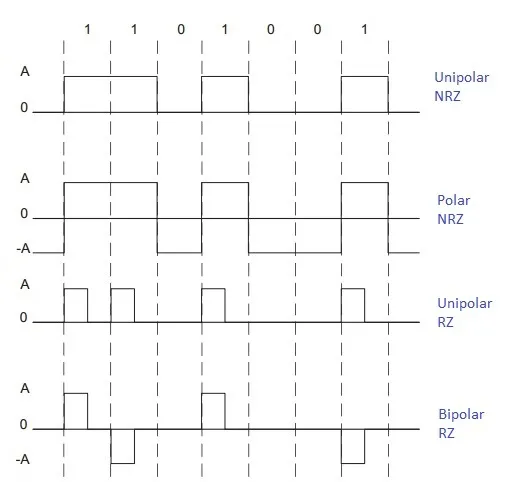
The figure depicts RZ and NRZ line encoding waveforms.
CRZ (Chirped Return-to-Zero)
-
Signal Characteristics: CRZ modulation involves applying a frequency chirp to the return-to-zero pulses, meaning the frequency of the pulse changes over time.
-
Waveform: Pulses that return to zero with a frequency chirp, resulting in a broader spectrum compared to standard RZ.
-
Advantages: Exhibits better resistance to dispersion and non-linear effects in optical fibers, improving performance over long distances.
-
Disadvantages: Requires more complex signal processing due to the chirping.
-
Applications: Used in advanced optical communication systems where dispersion management is critical.
CSRZ (Carrier-Suppressed Return-to-Zero)
-
Signal Characteristics: CSRZ is a variation of RZ where the phase of the carrier is alternated between adjacent bits, suppressing the carrier and improving performance.
-
Waveform: The signal returns to zero with phase alternation, resulting in a distinctive pattern.
-
Advantages: Offers better spectral efficiency, reduced nonlinear effects in optical fibers, and improved resistance to dispersion.
-
Disadvantages: Requires complex modulation and demodulation techniques.
-
Applications: Implemented in high-speed optical communication systems where bandwidth and performance are critical.
Continue Learning Forward Error Correction (FEC) & Channel Coding
- Forward Error Correction: Advantages & Disadvantages
- Convolutional Encoder Example
- Turbo Encoder Basics
- CIRC Encoding vs Decoding
- Differential Encoder/Decoder Explained
Explore AI & Audio Coders
- Rotary Encoder: Basics and Types
- Understanding Vocoding and Vocoders
- Autoencoder Function in 6G Networks
Explore Data Encoding Techniques
- Encoding vs Modulation: Understanding the Difference
- Manchester vs Differential Manchester Encoding
- 4B/5B Encoding: Advantages & Disadvantages
- 8B/10B Encoding: Advantages & Disadvantages
- 64B/66B vs 8B/10B Encoding Comparison
- HDB3 Encoding: Advantages & Disadvantages
- MLT-3 Encoding: Advantages & Disadvantages
- R8ZS Encoding: Advantages & Disadvantages