
What is 4D-PAM5 Line Coding : Advantages and Disadvantages
Advertisement
4D-PAM5 is a line coding technique used in Gigabit Ethernet that transmits data across four wire pairs using five signal levels. Advantages include high data throughput and efficient bandwidth utilization, while disadvantages include complex signal processing and susceptibility to noise. It is widely used in 1000BASE-T Ethernet systems.
4D-PAM5 Line Coding Procedure
4D-PAM5 (Four-Dimensional Five-Level Pulse Amplitude Modulation) is a multilevel signaling scheme. In this encoding method, data is transmitted simultaneously over four wires, utilizing five voltage levels: -2, -1, 0, 1, and 2. The ‘0’ level is specifically used for forward error detection.
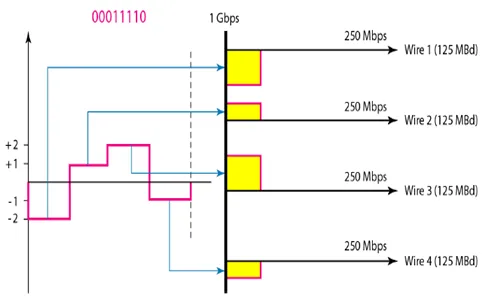
In this technique, all 8 bits are fed into the wire simultaneously and transmitted using a single signal element. Gigabit LANs employ this encoding technique to achieve 1 Gbps data transfer over four copper cables, capable of handling 125 Mbaud. Conceptually, if we consider the code as one-dimensional, the four levels resemble the 8B4Q line coding scheme.
Advantages of 4D-PAM5 Line Coding
The following are the benefits of using 4D-PAM5 line coding:
- Reduced Signal Rate: By sending data across four channels, the signal rate is reduced by N/8.
- Gigabit LAN Compatibility: It facilitates simultaneous data transmission over four wires in Gigabit LAN environments.
- Error Detection: Redundant data is used for forward error detection.
- Self Synchronization: 4D-PAM5 offers self-synchronization capabilities.
- Absence of DC Components: The encoded signal does not contain DC components.
Disadvantages of 4D-PAM5 Line Coding
The following are the drawbacks of using 4D-PAM5 line coding:
- Redundancy: 4D-PAM5 maps 28 data patterns to 44 signal patterns. This substantial mapping results in considerable redundancy in the signal patterns.
Summary
4D-PAM5 line coding enables Gigabit Ethernet communication using multiple signal levels. Advantages include high speed transmission, while disadvantages include increased implementation complexity and noise sensitivity.
Continue Learning Forward Error Correction (FEC) & Channel Coding
- Forward Error Correction: Advantages & Disadvantages
- Convolutional Encoder Example
- Turbo Encoder Basics
- CIRC Encoding vs Decoding
- Differential Encoder/Decoder Explained
Explore AI & Audio Coders
- Rotary Encoder: Basics and Types
- Understanding Vocoding and Vocoders
- Autoencoder Function in 6G Networks
Explore Data Encoding Techniques
- Encoding vs Modulation: Understanding the Difference
- Manchester vs Differential Manchester Encoding
- 4B/5B Encoding: Advantages & Disadvantages
- 8B/10B Encoding: Advantages & Disadvantages
- 64B/66B vs 8B/10B Encoding Comparison
- HDB3 Encoding: Advantages & Disadvantages
- MLT-3 Encoding: Advantages & Disadvantages
- R8ZS Encoding: Advantages & Disadvantages
- RZ, NRZ, CRZ, CSRZ Line Encoding Comparison