
Optical Fiber Cable (OFC): Advantages and Disadvantages
Advertisement
Optical Fiber Cable (OFC) carries digital information as light pulses through thin glass or plastic fibers, enabling high-speed and long-distance communication. It has become the backbone of modern broadband, telecom, and data center networks because of its high bandwidth and low transmission loss, despite higher installation and repair costs.
Introduction
Optical fibers have become commonplace for providing broadband internet connectivity. Optical fiber communication uses OFC as a transport medium to carry modulated light waves from a transmitting end to a receiving end.
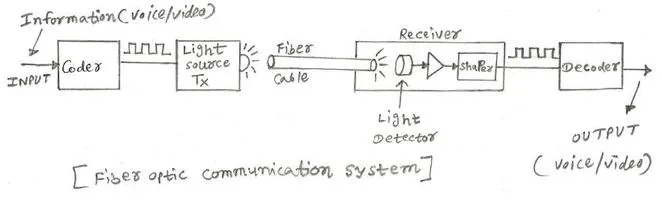
The OFC is made of plastic or glass. LEDs or laser diodes convert electrical signals to light signals at the transmitter, while photodiodes convert light signals back to electrical signals at the receiver.
What are modes in OFC?
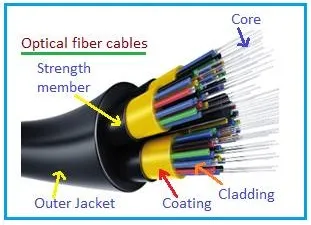
OFC consists of multiple bundles, each containing several optical fibers. These bundles are covered with protective layers and a strength member. Each bundle contains hair-like silicon core fibers, covered with cladding to prevent light leakage. An outer jacket protects the entire cable. This is illustrated in the figure below:
The core, made of thin glass, transports light between the two ends. The cladding reflects the light, enabling efficient transmission through the core.
There are two main types of OFCs: single-mode and multimode.
-
Single-mode OFC: Uses a single strand of glass fiber, with a diameter of 8.3 to 10 microns. It carries a single mode of light and supports higher bandwidth than multimode OFC. Offers higher transmission rates and can transmit data up to 50 times farther than multimode. Single-mode OFC is commonly used for inter-city telephone lines and video applications. Light waves with wavelengths of 1300 to 1320 nm can propagate through single-mode fiber.
-
Multimode OFC: Made of glass fibers with a diameter of 50 to 100 microns. Multimode OFC provides higher bandwidth at greater speeds over medium distances. Light waves with wavelengths of 850 or 1300 nm can travel through the core of multimode OFC.
Benefits or Advantages of OFC
- High Bandwidth: Data can be transmitted at Gbps speeds over the glass threads of OFC in the form of light pulses. This is much higher than copper wire. OFC supports a much wider bandwidth (> 10 GHz).
- Immunity to EMI: Light waves in OFC are not affected by electromagnetic interference (EMI), making it a more secure transmission method.
- Electrical Isolation: OFCs provide complete electrical isolation.
- Long-Distance Transmission: Data can travel for miles without significant signal degradation using OFC. Repeaters or amplifiers can be used to further extend the transmission distance.
- Environmental Resistance: OFCs are highly resistant to various environmental factors like temperature, corrosive liquids, and gases.
- Safety: OFCs pose no shock hazards because they are non-conductors.
- Low Attenuation: OFCs attenuate signals less than other wired transmission mediums.
- Small Size and Light Weight: OFCs are smaller and lighter than traditional copper cables.
- Ease of Installation: OFC installation is generally easier.
- Cost-Effective: OFCs are less expensive compared to other cable-based systems.
- Long Lifespan: Offers a longer lifespan, typically 30-50 years.
- Energy Efficient: Energy consumption per user is lower compared to copper wires.
- Durability: OFCs are highly durable.
Drawbacks or Disadvantages of OFC
- High Initial Cost: The initial installation cost of OFCs is relatively high.
- Difficult Splicing: Splicing OFCs is more complex than splicing wires, especially at the starting and ending joints. Specialized techniques, skilled manpower, and expensive equipment are required.
- Fragility: OFCs have weaker physical and tensile strength compared to copper cables.
- Remote Power Requirement: It requires remote electric power.
- Expensive Connectors and Tools: OFCs require expensive connectors and tools, making maintenance and repairs more difficult and costly.
- Increased Protection: OFCs require more protection around the cable compared to copper wires.
Summary
Optical Fiber Cable (OFC) is a transmission medium that carries data as light signals through optical fibers. It provides very high bandwidth, low signal attenuation, and immunity to electromagnetic interference. However, installation costs are higher, and fiber cables require careful handling due to their fragile construction.
Continue Learning RF & Coaxial Cables
- RF Cables: Advantages and Disadvantages
- RF Semi-Rigid vs Flexible Cables
- Coaxial Cable Types
- Coaxial Cable: Advantages & Disadvantages
- Wire vs Cable Differences
Explore Networking, Telecom & Industrial Cables
Explore More Optical Networking Components
- Optical Switching Basics
- Optical Transceiver Explained
- Optical Add-Drop Multiplexer (OADM) Explained
- What is a ROADM (Reconfigurable Optical Add-Drop Mux)?
- Optical Fiber Connectors (FC, SC, ST, LC, DIN)
- Optical Amplifiers & Repeaters
- Optical Wavelength Converters
- Optical Filter Basics
- Optical Equalizer Basics
- Optical Transimpedance Amplifier
- Optical Sensors: Advantages & Disadvantages
- Optical Biosensors: Working, Types & Applications