
What are RF Cables: 10 Advantages and Disadvantages
Advertisement
RF cables are specialized coaxial cables designed to transmit radio frequency signals with minimal attenuation between communication and electronic equipment. Their advantages include excellent signal shielding and low transmission loss, while their disadvantages include higher installation costs and signal degradation over extended cable lengths.
RF Cables Selection Guide, Types & Key Features
RF cables are specialized cables designed to efficiently transmit radio frequency (RF) signals in a confined medium. They are typically coaxial in nature.
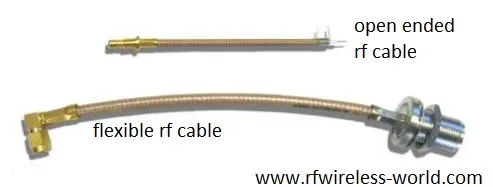
RF cables serve as the vital link for coupling RF signals between different components within RF units, RF test equipment, and more. An open-ended RF cable can even be used to probe RF signals at various points on an RF circuit board.
Most RF cables are coaxial, featuring a central copper conductor surrounded by a dielectric (insulating) plastic layer. This insulator is then encased in a protective layer, often made of braided aluminum or copper. This outer layer shields the data traveling in the center conductor from external electromagnetic (EM) interference.
There are several types of RF coaxial cables, including:
- Flexible cable
- Twin-axial cable
- Tri-axial cable
- Rigid cable
- Semi-rigid cable
- Semi-flex cable
- Formable coaxial cables
Key Specifications of RF Cables
- Frequency Range: The range of frequencies the cable can handle while delivering the desired performance.
- Impedance: The electrical resistance of the cable at both ends, measured in Ohms.
- Insertion Loss: The amount of signal loss across the cable’s length, measured in dB.
- Return Loss: Measures the amount of power reflected back due to impedance mismatch. It is measured in dB and can also be expressed as VSWR (Voltage Standing Wave Ratio).
- Connector Types: Cables are custom-made to order with the connectors you need on each end. Popular RF connectors (male and female) include N-type, SMA, TNC, and BNC.
- Material: The material used in the cable’s construction is important for its durability and performance.
- Shielding Effectiveness: How well the cable shields the signal from external interference or noise.
- Temperature Range: The range of temperatures the cable can operate within without performance degradation.
- Size: The length and thickness of the cable.
Benefits or Advantages of RF Cables
- RF cables are designed for transmitting signals in high frequency ranges, making them essential in wireless communication systems, satellite systems, and TV stations.
- Flexible RF cables are easy to route and connect, simplifying installation in tight spaces.
- RF cables introduce minimal attenuation loss, preserving signal quality.
- They are durable and can withstand harsh environmental conditions like extreme temperatures and humidity.
- RF cables can be easily customized to any length with a variety of RF connectors like SMA, N-type, BNC, and TNC.
- The shielding in RF cables prevents external EM signals or noise from interfering with the transmitted RF signal.
- RF cables are generally cost-effective.
- Using RF cables poses no electrical shock hazards.
- They are lightweight and compact.
- RF cables are designed to meet strict safety and performance compliance standards.
Drawbacks or Disadvantages of RF Cables
- RF cables cause signal attenuation over distance, limiting their use to shorter transmission distances.
- RF cables have limited flexibility (bend radius) in routing, making them unsuitable for some applications.
- Environmental factors (temperature, humidity) and regular usage can degrade RF cables, impacting signal quality over time.
Summary
RF cables ensure reliable high-frequency signal transmission across communication, broadcasting, aerospace, and laboratory applications. Their superior shielding and electrical performance provide significant operational advantages, although cable quality, length, and installation practices directly influence overall system efficiency.
Continue Learning RF & Coaxial Cables
- RF Semi-Rigid vs Flexible Cables
- Coaxial Cable Types
- Coaxial Cable: Advantages & Disadvantages
- Wire vs Cable Differences