
Optical Repeater vs. Optical Amplifier: Key Differences
Advertisement
When signals travel from a source to a destination, whether through a wire or the air, they inevitably undergo changes and distortions due to the path conditions. This leads to signal attenuation, or energy loss. In wires, this is mainly due to the resistance (R), inductance (L), and capacitance (C) components. In optical fibers, attenuation results from the absorption and scattering of light. Beyond attenuation, noise also accumulates along the signal path. All of these factors can make it difficult to accurately decode transmitted information.
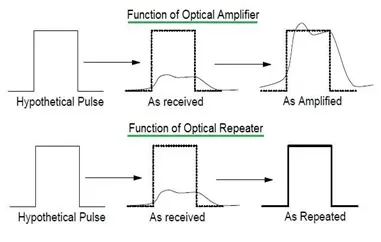
To counteract these effects, amplifiers or repeaters are strategically placed along the path between the source and the destination. Let’s delve into the differences between optical amplifiers and optical repeaters.
Optical Amplifier
- An optical amplifier amplifies the optical signal directly.
- Critically, it amplifies the entire signal, including any noise that has accumulated during transmission.
- As the amplified, distorted signal continues its journey, the noise component also gets further distorted, potentially compounding the problem.
- Optical amplifiers are best suited for shorter transmission distances between the transmitter and receiver.
- They are typically placed at shorter intervals along the path.
Optical Repeater
- An optical repeater receives the optical signal and converts it into an electrical signal.
- It then performs reshaping and amplification operations on the electrical signal before converting it back into an optical signal for re-transmission.
- By reconstructing the signal before amplification, the repeater significantly reduces signal distortion caused by noise and other impairments.
- Optical repeaters can be placed at longer distances compared to optical amplifiers.
Key Differences Summarized
The primary difference lies in how they deal with the signal. The optical amplifier simply amplifies the optical signal as-is, including noise. The optical repeater, however, regenerates the signal, effectively cleaning it up before re-transmission. This regeneration makes repeaters much more effective at maintaining signal integrity over longer distances.
Continue Learning Fiber Optic Fundamentals & Tutorials
- Understanding Optical Fiber Communication
- Understanding Plastic Optical Fiber
- Fiber Optic Sensors: Types, Working Principles & Applications
- RF Over Fiber: Advantages, Disadvantages & Key Differences
- THz to Optical Conversion in 6G Wireless
- Quantum Key Distribution Over Fiber
- Optical Circuit Switching vs Burst Switching vs Packet Switching
Technology Comparisons (Fiber vs. Others)
- Fiber vs Microwave
- Copper vs Fiber Optic Cable Comparison
- Glass Optical Fiber vs Plastic Optical Fiber (GOF vs POF)
- Active vs Passive Optical Networks (AON vs PON)
- 5G vs Fiber Optic
Explore More Optical Networking Components
- Optical Switching Basics
- Optical Transceiver Explained
- Optical Add-Drop Multiplexer (OADM) Explained
- What is a ROADM (Reconfigurable Optical Add-Drop Mux)?
- Optical Fiber Connectors (FC, SC, ST, LC, DIN)
- Optical Amplifiers & Repeaters
- Optical Wavelength Converters
- Optical Filter Basics
- Optical Equalizer Basics
- Optical Transimpedance Amplifier
- Optical Sensors: Advantages & Disadvantages
- Optical Biosensors: Working, Types & Applications