
Optical Add-Drop Multiplexer (OADM) Explained
Advertisement
An Optical Add-Drop Multiplexer (OADM) is a crucial component in Wavelength Division Multiplexing (WDM) optical networks. Let’s break down how it works.
As shown in the figure below, an optical multiplexer combines multiple wavelength signals into a single optical fiber. The same device acts as a de-multiplexer in the reverse direction and separates the signals of different wavelengths.

Figure-1: Optical multiplexer demultiplexer
The core function of an OADM is to selectively add and drop specific wavelengths from a multi-wavelength optical signal, allowing other wavelengths to pass through unaffected. Think of it like a highway off-ramp, but for light signals!
As shown in the figure below, optical ADM drops and adds a selective number of Wavelengths from a WDM signal, while permitting remaining wavelengths to pass through itself. Optical ADM architectures are mainly of three types viz. parallel, serial and band drop.
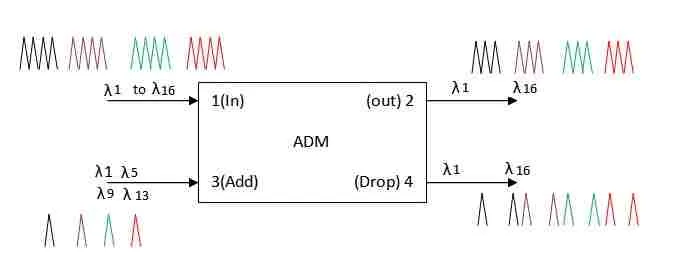
Figure-2: ADM-Add Drop Multiplexer
OADM Architectures and Topologies
Optical ADM architectures are mainly of three types:
- Parallel: (Details not provided in the original text)
- Serial: (Details not provided in the original text)
- Band Drop: (Details not provided in the original text)
Typically, OADMs are deployed in linear or ring topologies within optical networks. Figure-2 depicts a basic Add-Drop Multiplexer setup where 16 channels enter at PORT-1, 8 channels are dropped at PORT-4, and the remaining channels continue through PORT-2. Simultaneously, 4 new channels are introduced into PORT-3 and combined with the signal stream emerging from PORT-2.
Types of Optical ADMs: Fixed vs. Reconfigurable
There are two primary types of Optical ADMs used in WDM optical networks:
- Fixed OADMs: These are designed to add or drop signals on specific, predetermined WDM channels. They offer a static configuration for dedicated wavelength management.
- Reconfigurable OADMs (ROADMs): These more advanced OADMs provide the capability to dynamically alter the selected channel route via electronic control along the fiber optic network.
Benefits of Reconfigurable OADMs
ROADMs offer significant advantages:
- Fault Tolerance: They can reroute optical streams in the event of network faults, minimizing service disruption.
- Network Upgradability: ROADMs facilitate upgrades to optical networks based on new and different WDM technologies, offering flexibility in evolving network architectures.
Continue Learning Multiplexers (Mux & Demux)
- Mux vs Demux
- Concentrator vs Multiplexer
- AWG (Arrayed Waveguide Grating) Optical Mux/Demux
- Transponder vs Muxponder
Explore Technical Comparisons
Explore More Optical Networking Components
- Optical Switching Basics
- Optical Transceiver Explained
- Optical Add-Drop Multiplexer (OADM) Explained
- What is a ROADM (Reconfigurable Optical Add-Drop Mux)?
- Optical Fiber Connectors (FC, SC, ST, LC, DIN)
- Optical Amplifiers & Repeaters
- Optical Wavelength Converters
- Optical Filter Basics
- Optical Equalizer Basics
- Optical Transimpedance Amplifier
- Optical Sensors: Advantages & Disadvantages
- Optical Biosensors: Working, Types & Applications