
What is Copper Wire over fiber : Advantages and Disadvantages
Advertisement
Copper wire and fiber optic cables are widely used transmission media for networking and communication systems. Copper offers lower installation costs and power delivery capability, while fiber provides higher bandwidth and longer transmission distances. Each technology has unique advantages and disadvantages related to cost, performance, and deployment requirements.
Introduction : Copper wire is a physical transmission medium used to transfer data between a transmitter and a receiver in a data communication system. It’s primarily used in two forms: twisted pair cable and coaxial cable. Fiber optic cable is another popular wired communication medium.
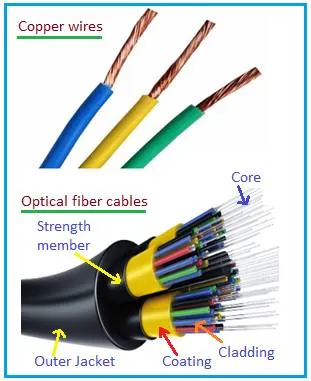 Image alt: Copper vs Fiber
Data can be transported through wired (guided/conducted) or wireless (unguided) mediums. Copper and fiber fall under the wired category, while microwave, radio, infrared, and satellite communication are wireless.
The three major characteristics of any transmission medium are:
- Bandwidth/Data Rate: The amount of data that can be transmitted per unit of time.
- Delay/Latency: The time it takes for data to travel from source to destination.
- Signal Loss: The weakening of the signal as it travels through the medium.
Copper wires offer medium bandwidth, low delay, and varying signal loss compared to other media. They use electrical signals for transmission.
Advantages of Copper Wire over Fiber
Following are some of the benefits of copper wire.
- Lower Initial Installation Cost: Copper is generally cheaper to install than fiber. Plus, it doesn’t require highly specialized installation skills.
- Easy and Cheaper Maintenance: Maintaining copper cable systems is typically easier and less expensive than fiber optic systems.
- Supports All Radio Frequencies: Unlike fiber optic cables, copper supports all radio frequencies.
- Durable: Copper is a durable material, similar to fiber optic cable.
- Supports a Wide Range of Bandwidths: Copper can handle bandwidths from 10 Mbps to 10 Gbps.
- Lower Media and Connector Costs: Copper media and connectors are generally less expensive than their fiber optic counterparts.
- Fewer Safety Precautions: Handling copper cables typically requires fewer safety precautions compared to working with fiber optics.
Disadvantages of Copper Wire over Fiber
Following are some of the drawbacks of copper wire.
- Susceptible to EMI: Copper is more susceptible to electromagnetic interference (EMI) than fiber optic cables. (Coaxial cable versions are more resistant to RFI/EMI, however.)
- Security Concerns: Copper wires are susceptible to tapping, making hacking easier.
- Limited Cable Length: Copper cables typically support a maximum cable length of 100 meters. Fiber optic cables can support ranges of kilometers.
- Vulnerable to Electrical Hazards: Copper offers low immunity to electrical hazards, whereas fiber optic cable is completely immune.
- Thicker and Larger Diameter: Copper wires are generally thicker and have a larger diameter than fiber optic cables.
- Lower to Medium Bandwidth: Copper supports low to medium bandwidth compared to the very high bandwidth capabilities of fiber optic cables.
- Higher Signal Loss: Copper cables experience more signal loss than fiber optic cables.
Summary
Copper and fiber cables serve different networking needs. Copper offers affordability and power delivery, while fiber provides superior bandwidth, speed, and long-distance communication capabilities.