
What are Submarine Cables: Advantages and Disadvantages
Advertisement
Submarine cables are fiber optic communication cables installed on the ocean floor to carry international voice, Internet, and data traffic between continents. Their advantages include enormous bandwidth capacity and reliable long-distance connectivity, whereas their disadvantages include high installation costs, difficult repairs, and vulnerability to physical damage.
Introduction : Undersea cables are used for various applications, including telecommunications, oil and gas exploration/extraction, and electric power transportation. Leading vendors of submarine fiber cables include Fujitsu, Alcatel Submarine Networks, NEC, Huawei Marine Networks, and TE SubCom.
Submarine Communication Cable Structure and parts
Submarine cables for telecommunications are designed for high capacity and greater security, carrying about 95% of transoceanic voice and data traffic. Big content providers like Google, Facebook, Amazon, and Microsoft have invested in undersea cables to support their cloud computing, data storage, and streaming applications.
Submarine cable installation involves analyzing the undersea path using specialized software like Malai Ocean Engineer. Makai smart software tools aid in planning and installation, providing position and bottom tension data at any depth based on the cable laid path. MakaiLay software also offers 3D current profiles to assist in undersea cable installations.
SubCom is a leading company specializing in the installation, maintenance, and operation of undersea data transport networks.
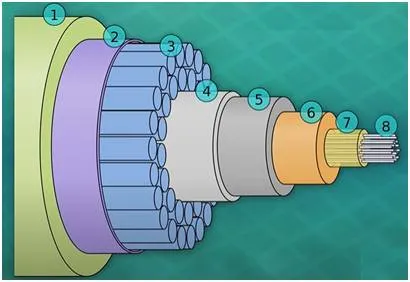
Submarine cable structure
The submarine cables carrying internet traffic consist of several layers. Data is transmitted through optical fiber cables (OFCs):
- Tar Coating
- Mylar Tape
- Thick Stranded Steel Wires
- Aluminum Water Barrier
- Polycarbonate Layer
- Copper Tubing
- Petroleum Jelly
- Optical Fibers
Fiber optic submarine cables rely on the properties of pure glass fibers to guide light waves through internal reflection. Due to signal loss, repeaters are required at regular intervals. Armored fiber optic cables are typically 50 mm in diameter.
Benefits or advantages of Submarine Communication Cables
- Undersea cables can withstand rocky sea beds, marine animals, tsunamis, volcanoes, and even the occasional shark attack.
- Designed for high bandwidth and low latency.
- Offer high reliability and greater security due to the difficulty of tapping into them.
- Very cost-effective compared to satellites.
- Optical fiber cables offer low power loss and are immune to electromagnetic interference.
- Greater tensile strength compared to copper and steel fibers of the same dimensions.
- Flexible and lighter in weight.
- Essentially non-polluting.
- Undersea cable networks are designed to last for around 25 years.
Drawbacks or disadvantages of Submarine Cables
- Not suitable for regions vulnerable to disasters like mudslides or typhoons, where satellites are a better option.
- Not ideal for remote villages, terrains, small island nations, and hilly regions.
- Installation is slow, tedious, and expensive.
- Repairs can be time-consuming.
- Continuous threats from shipping and fishing activities.
- Require repeaters at regular intervals to boost the signal.
- Potentially used for espionage by countries during wartime.
- Costly, requiring significant investment for fiber network installation.
Summary
Submarine cables serve as the backbone of global Internet infrastructure by enabling fast, high capacity international communication between countries and continents. Their connectivity advantages support worldwide digital services, although maintenance challenges, deployment costs, and environmental risks require continuous management.
Continue Learning RF & Coaxial Cables
- RF Cables: Advantages and Disadvantages
- RF Semi-Rigid vs Flexible Cables
- Coaxial Cable Types
- Coaxial Cable: Advantages & Disadvantages
- Wire vs Cable Differences