
What is Glass Optical Fiber : Advantages and Disadvantages
By RF Wireless Expert Team
Advertisement
Glass optical fiber is a transmission medium made from ultra-pure glass that carries data as light signals over long distances. It is widely used in telecommunications, broadband networks, and data centers. Advantages include high bandwidth and low attenuation, while disadvantages include fragility and higher installation costs compared to copper cables.
Key Features & Structure of Glass Optical Fiber
- A fiber optic system consists of three main components: a light source, a transmission medium, and a light receiver.
- Glass optical fiber serves as the transmission medium. It’s composed of a thin, hair-like dielectric material made of glass or silica, with a circular cross-section.
- The cable has three layers:
- Core: The central part is the core, the medium through which light propagates.
- Cladding: A layer surrounding the core.
- Protective Jacket: The outermost layer provides protection.
- The core facilitates light propagation from one end to the other.
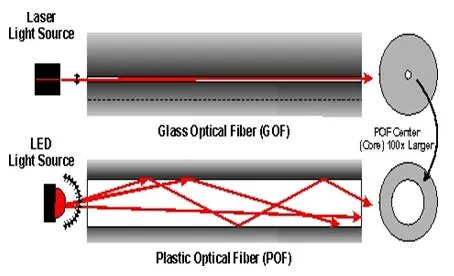
Difference between Plastic Optical Fiber and Glass Optical Fiber
- GOFs are made of glass strands encased in a protective sheathing (e.g., stainless steel).
- Figure 1 (not included in the text but referenced) likely depicts the basic structure of a glass optical fiber.
- GOF typically operates in the infrared wavelength range.
- Light can travel over considerable distances because the cladding doesn’t absorb light from the core. Some light degradation occurs due to impurities within the glass.
- The base material for textile-grade glass optical fiber is silica (SiO2).
Advantages of Glass Optical Fiber
The following are the key benefits of using Glass Optical Fiber.
- Durability and Temperature Resistance: GOFs are durable and can withstand a wide temperature range (-40°F to +900°F). This makes them suitable for use in both high-temperature appliances (ovens, furnaces, condensers) and low-temperature environments (cold storage warehouses).
- Long Distance Communication: With a lower loss per kilometer (around 2.9 dB/km), it is preferred for long-distance communication applications.
- High Bandwidth Support: It can support the transmission of high-bandwidth signals, making it ideal for home networking solutions.
- Immunity to Interference: Glass optical fiber cables are immune to electromagnetic interference (EMI) and radio frequency interference (RFI).
- Thin and Lightweight: They are thin and light in weight, allowing for optimization in small spaces and targeted applications.
Disadvantages of Glass Optical Fiber
Following are the primary drawbacks associated with using Glass Optical Fiber.
- Higher Cost: The cost of glass fiber is higher compared to plastic fiber. Additionally, the test equipment required is also more expensive.
- Difficult Light Coupling: Its core diameter is very small (approximately 0.062 mm), making it challenging to couple light efficiently into the core region.
- Installation Complexity: Installation and termination are more complex processes. Connectorization takes longer and demands specialized tools and training.
- Brittleness: Unlike flexible plastic fiber, glass fiber is brittle.
Summary
Glass optical fibers provide high speed data transmission with minimal signal loss. Advantages include long distance communication and large bandwidth, while disadvantages include fragility and deployment expenses.
Continue Learning Fiber Optic Fundamentals & Tutorials
- Understanding Optical Fiber Communication
- Understanding Plastic Optical Fiber
- Fiber Optic Sensors: Types, Working Principles & Applications
- RF Over Fiber: Advantages, Disadvantages & Key Differences
- THz to Optical Conversion in 6G Wireless
- Quantum Key Distribution Over Fiber
- Optical Circuit Switching vs Burst Switching vs Packet Switching
Technology Comparisons (Fiber vs. Others)
- Fiber vs Microwave
- Copper vs Fiber Optic Cable Comparison
- Glass Optical Fiber vs Plastic Optical Fiber (GOF vs POF)
- Active vs Passive Optical Networks (AON vs PON)
- 5G vs Fiber Optic
Explore More Optical Networking Components
- Optical Switching Basics
- Optical Transceiver Explained
- Optical Add-Drop Multiplexer (OADM) Explained
- What is a ROADM (Reconfigurable Optical Add-Drop Mux)?
- Optical Fiber Connectors (FC, SC, ST, LC, DIN)
- Optical Amplifiers & Repeaters
- Optical Wavelength Converters
- Optical Filter Basics
- Optical Equalizer Basics
- Optical Transimpedance Amplifier
- Optical Sensors: Advantages & Disadvantages
- Optical Biosensors: Working, Types & Applications