
What is Optical Transimpedance Amplifier (TIA)
Advertisement
An Optical Transimpedance Amplifier (TIA) is an electronic circuit that converts the small current generated by a photodetector into a usable voltage signal. TIAs are essential components in optical receivers, fiber optic communication systems, LiDAR devices and high speed photonic applications requiring accurate signal amplification.
The transimpedance amplifier typically consists of a photodiode and an operational amplifier, as illustrated in the figure below. The primary function of a transimpedance amplifier is to convert the current produced by the photodiode into a differential voltage. One end of the photodiode is connected to the ground, while the other end is held at a potential equal to the virtual ground due to the inverting input of the amplifier. Let us understand working principle of this optical transimpedance amplifier.
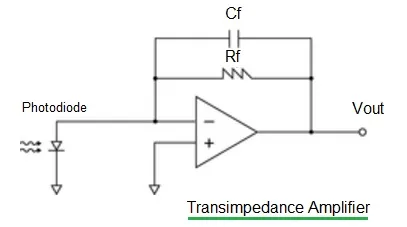
- When light falls on the photodiode, it generates a current proportional to the light input.
- The transimpedance amplifier forces this generated current to flow through a feedback resistor (Rf).
- This process results in the generation of a voltage at the amplifier output.
The relationship between the voltage (V), current (i), and feedback resistance (Rf) is defined by the following equation:
Since the value of Rf is known, the current can be accurately estimated using the measured voltage.
Features of Transimpedance Amplifiers:
- High input current handling
- Low power dissipation
- Low input noise current (referred to input)
Applications of Optical Transimpedance Amplifiers
Optical Transimpedance Amplifiers find applications in various scenarios, including:
- Fiber Channel Configurations: Used in various fiber channel configurations such as 1X, 2X, 4X, 8X etc.
- 10 Gigabit Ethernet: Employed in 10 Gigabit Ethernet systems.
- SONET and SDH: Utilized in SONET (Synchronous Optical Networking) and SDH (Synchronous Digital Hierarchy) systems.
- 10GBase-LX4 Fiber Optic Network: Found in 10GBase-LX4 fiber optic networks.
Continue Learning Fiber Optic Fundamentals & Tutorials
- Understanding Optical Fiber Communication
- Understanding Plastic Optical Fiber
- Fiber Optic Sensors: Types, Working Principles & Applications
- RF Over Fiber: Advantages, Disadvantages & Key Differences
- THz to Optical Conversion in 6G Wireless
- Quantum Key Distribution Over Fiber
- Optical Circuit Switching vs Burst Switching vs Packet Switching
Technology Comparisons (Fiber vs. Others)
- Fiber vs Microwave
- Copper vs Fiber Optic Cable Comparison
- Glass Optical Fiber vs Plastic Optical Fiber (GOF vs POF)
- Active vs Passive Optical Networks (AON vs PON)
- 5G vs Fiber Optic
Explore More Optical Networking Components
- Optical Switching Basics
- Optical Transceiver Explained
- Optical Add-Drop Multiplexer (OADM) Explained
- What is a ROADM (Reconfigurable Optical Add-Drop Mux)?
- Optical Fiber Connectors (FC, SC, ST, LC, DIN)
- Optical Amplifiers & Repeaters
- Optical Wavelength Converters
- Optical Filter Basics
- Optical Equalizer Basics
- Optical Transimpedance Amplifier
- Optical Sensors: Advantages & Disadvantages
- Optical Biosensors: Working, Types & Applications