
Optical Equalizer: Basics and Specifications
Advertisement
As we know, “equalizer” refers to a device that equalizes the input signal over a specific range. In the optical domain, an equalizer is a device that equalizes the gain response over a particular wavelength range.
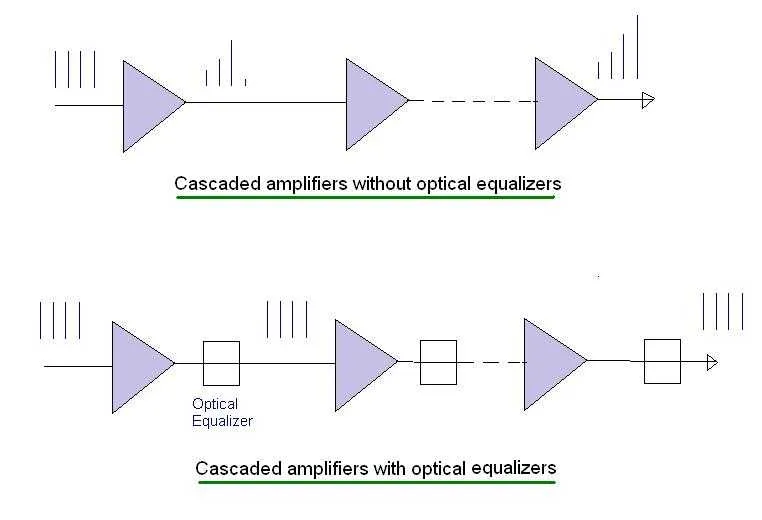
The main reason for this equalization is to enable the cascading of amplifiers, making it possible to transmit signals over long distances without distorting the signal envelope. Optical amplifier gain varies at different wavelengths. Even a small variation between two wavelength channels can result in a large variation after a few stages of amplification in the optical chain. To avoid this situation, equalization is performed at regular intervals. The best approach is to equalize after each amplifier device.
In WDM systems, optical equalizers with multi-channel options are incorporated after each EDFA (Erbium-Doped Fiber Amplifier) device. This helps cascade the EDFA chain to achieve the goal of long-distance optical signal transmission. WDM channel equalizers are available in 8-channel and 16-channel options. Filtering is incorporated inside the equalizer to filter out unwanted wavelengths and segregate the desired ones.
The following figure illustrates this concept:
Here are typical specifications for a dynamic gain equalizer used for 10 Gbps and 40 Gbps optical networks (in DWDM systems). This allows for cascading about 50 optical amplifiers, which helps extend the range of optical fiber to a distance of approximately 5000 km.
Optical Equalizer Specifications
- Band of operation: L band, C band, or any other band
- Insertion loss: Around 5.5 dB
- Resolution: Less than 2.6 nm
- Polarization Dependent Loss (PDL): Less than 0.3 dB
- Polarization Mode Dispersion: Less than 0.3 ps
- Dynamic Range: 15 dB
- Optical Response Time: Max. 30 ms
Continue Learning Fiber Optic Fundamentals & Tutorials
- Understanding Optical Fiber Communication
- Understanding Plastic Optical Fiber
- Fiber Optic Sensors: Types, Working Principles & Applications
- RF Over Fiber: Advantages, Disadvantages & Key Differences
- THz to Optical Conversion in 6G Wireless
- Quantum Key Distribution Over Fiber
- Optical Circuit Switching vs Burst Switching vs Packet Switching
Technology Comparisons (Fiber vs. Others)
- Fiber vs Microwave
- Copper vs Fiber Optic Cable Comparison
- Glass Optical Fiber vs Plastic Optical Fiber (GOF vs POF)
- Active vs Passive Optical Networks (AON vs PON)
- 5G vs Fiber Optic
Explore More Optical Networking Components
- Optical Switching Basics
- Optical Transceiver Explained
- Optical Add-Drop Multiplexer (OADM) Explained
- What is a ROADM (Reconfigurable Optical Add-Drop Mux)?
- Optical Fiber Connectors (FC, SC, ST, LC, DIN)
- Optical Amplifiers & Repeaters
- Optical Wavelength Converters
- Optical Filter Basics
- Optical Equalizer Basics
- Optical Transimpedance Amplifier
- Optical Sensors: Advantages & Disadvantages
- Optical Biosensors: Working, Types & Applications