What is Dichroic Filter: Definition and Functionality
Advertisement
A dichroic filter is an optical filter designed to selectively transmit specific wavelengths of light while reflecting others. Using thin film interference technology, dichroic filters are widely employed in lasers, spectroscopy, imaging systems, fluorescence microscopy, telecommunications and optical sensing applications requiring precise wavelength separation. This page explains the basics of a Dichroic filter and its function, particularly in a fiber optic network context.
What is WDM
WDM is a multiplexing technique that combines optical signals of different wavelengths. Generally, a “filter” refers to a device that allows some frequencies to pass through while blocking or rejecting others. Common types include Low Pass Filters, High Pass Filters, Band Pass Filters and Band Stop Filters.
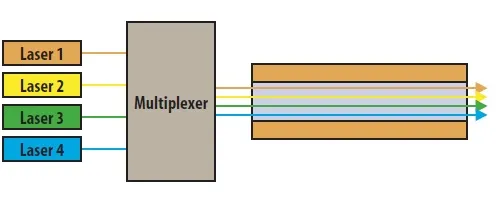
Just as frequency-based filters operate on different frequencies, a Dichroic filter operates on different wavelengths of light. It’s a very precise color filter.
Function of a Dichroic Filter
A Dichroic filter passes light within a specific wavelength range and reflects light in another wavelength range. Its selective wavelength manipulation makes it particularly useful in WDM networks.
In WDM systems, Dichroic filters are used to combine (multiplex) and separate (demultiplex) different wavelengths of light, enabling the transmission of multiple data channels over a single optical fiber.
Explore More Optical Filters
- Optical Filter Basics
- Fabry-Perot Filter / Interferometer Cavity
- Acousto-Optic Tunable Filter Basics
Continue Learning Filter Fundamentals & Terminology
- Lumped Element Filter : Key Advantages & Disadvantages
- Microstrip Based RF Low Pass Filter Design Example
- Understanding Filter Terms
- RF Filters : Types, Selection Guide, Advantages & Disadvantages
- Active vs Passive Filters
- Analog vs Digital Filters
- Butterworth, Chebyshev, Bessel, and Elliptic Filters
- FIR Filter vs IIR Filter
- Understanding CIC (Cascaded Integrator-Comb) Filters
- Pi Filter: Advantages & Disadvantages
- Active vs Passive Harmonic Filters