
What is RF over Fiber: Advantages and Disadvantages, Differences
Advertisement
RF over Fiber (RFoF) is a communication technology that transports analog radio frequency signals over optical fiber while preserving their original characteristics. Its advantages include long distance transmission and low signal attenuation, whereas its disadvantages include optical component costs, system complexity, and stringent performance requirements.
Introduction : RF over Fiber (RFoF) was developed to address the limitations of traditional coaxial cables in transmitting high frequency RF signals over long distances with minimal signal loss and interference. Emerging in the 1980s and 1990s, RFoF technology leveraged the low attenuation and high bandwidth capabilities of optical fiber to improve the performance of communication systems, including satellite and terrestrial broadcasting. Its development was driven by the need for higher quality and more reliable signal transmission in environments such as broadcast networks and military applications, where signal integrity is crucial.
RF Over Fiber Transmitter and its working
RF over Fiber (RFoF) refers to the technology that transmits radio frequency (RF) signals over optical fiber cables. It combines the high-frequency transmission capabilities of RF with the advantages of optical fiber, such as low signal loss and immunity to electromagnetic interference. This technology is commonly used in applications like satellite communication, cellular networks, and broadcasting, where high-frequency signals need to be transmitted over long distances with minimal loss and interference.
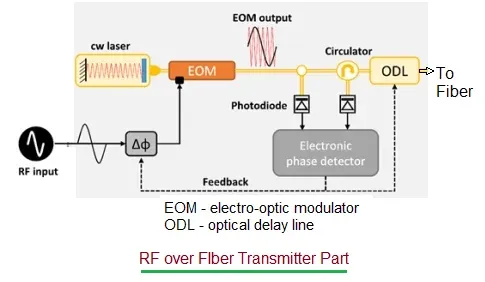 Image Courtesy : Cycle GmbH
The figure depicts the transmitter part of an RFoF system. It uses an Electro-Optic Modulator (EOM) device, which modulates the properties of a light beam, such as its amplitude, phase, or polarization, in response to an applied electrical radio frequency (RF) signal. The receiver part consists of a photodiode detector, filter, and amplifier to reproduce the appropriate RF output signal.
Benefits or Advantages of RF Over Fiber
- Optical fibers have significantly lower signal attenuation compared to traditional coaxial cables, allowing RF signals to travel longer distances without degradation.
- Optical fibers are immune to EMI, which ensures that RF signals remain clean and unaffected by external electrical noise, making them ideal for environments with high interference.
- Optical fibers can carry a wide range of frequencies simultaneously, allowing for high data throughput and the transmission of multiple RF signals over a single fiber.
- Fiber optic cables are lighter and more flexible than traditional RF cables, making installation easier and reducing infrastructure costs.
- Since optical signals do not emit electromagnetic radiation, RF over fiber is more secure and less susceptible to eavesdropping.
Drawbacks or Disadvantages of RF Over Fiber
- The installation of RF over fiber systems can be expensive due to the cost of fiber optic cables, transmitters, receivers, and specialized equipment (if required).
- Maintaining RF over fiber systems requires specialized knowledge and equipment, which can complicate troubleshooting and repairs.
- Optical fibers have limitations on the amount of optical power that can be transmitted, which can affect the signal strength over very long distances or in high-power applications.
- Optical fibers can be sensitive to bending, stretching, or physical damage, which can affect signal quality if not handled properly.
- RF signals need to be converted into optical signals and back again at the receiving end, which introduces additional points of potential failure and complexity.
Comparison between RF and Fiber
| Feature | RF | Fiber |
|---|---|---|
| Medium | Radio waves | Optical fibers transmitting light |
| Bandwidth | Limited; lower data rates. | Very high; supports high data rates. |
| Transmission Range | Short to medium distances, high loss. | Long distances with minimal signal loss. |
| Interference | Susceptible to EMI and environmental noise. | Immune to EMI, providing stable performance. |
| Latency | Higher latency due to signal processing delays. | Lower latency, ideal for real-time applications. |
| Installation Cost | Lower, uses simple antennas and transmitters. | Higher, requires specialized cables and transceivers. |
| Installation Complexity | Simple, easy to set up. | Complex, requires precise installation and alignment. |
| Scalability | Limited scalability. | Highly scalable for high bandwidth needs. |
| Security | Easier to intercept and jam. | Highly secure, difficult to tap without detection. |
| Use cases (Typical) | Broadcasting, local wireless communications | High speed data networks, backbone links |
Summary
RF over Fiber combines the strengths of optical fiber and RF communication to support distributed antenna systems, satellite communications and broadband wireless infrastructure. Its transmission advantages significantly improve coverage and signal quality, although deployment costs and optical system design remain important implementation factors.
Explore More RF Test Cases
- RF Receiver Sensitivity Measurement
- RF Receiver Overload Test Measurement
- RF Phase Noise Measurement
- ACPR Measurement
- RF Harmonic Distortion Measurement
- RF Intermodulation Distortion Measurement
- RF Gain Flatness Measurement
- RF Filter Measurements
- RF Antenna Measurements & Optimization
- RF Synthesizer Settling Time Measurement
Continue Learning Fiber Optic Fundamentals & Tutorials
- Understanding Optical Fiber Communication
- Understanding Plastic Optical Fiber
- Fiber Optic Sensors: Types, Working Principles & Applications
- RF Over Fiber: Advantages, Disadvantages & Key Differences
- THz to Optical Conversion in 6G Wireless
- Quantum Key Distribution Over Fiber
- Optical Circuit Switching vs Burst Switching vs Packet Switching