
What is Argon Laser : Advantages and Disadvantages
Advertisement
An argon laser is a gas laser that uses ionized argon gas to generate visible blue green laser light. It is widely used in medical, scientific, industrial, and research applications. Advantages include high beam quality and stable output, while disadvantages include high power consumption, cooling requirements, and maintenance costs.
About Argon Laser basics
- An Argon laser is a type of gas laser that operates within the visible spectrum, typically around 0.488 µm wavelength.
- It can function in both continuous wave (CW) and pulsed modes.
- Figure 1 illustrates the schematic structure of an Argon laser.
- In this laser, pumping is achieved through a high-voltage electric discharge through the argon gas filled tube, employing either Direct Current (DC) or Radio Frequency (RF) processes.
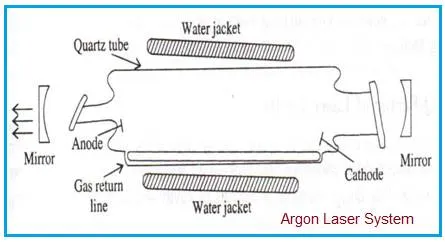
- A cooling jacket is essential due to the significant heat generated during operation.
- Lasing occurs due to electron transitions from the 4p energy level to the 4s level within the ionized state of the argon gas.
- The average output power ranges from 0.005 to 20 Watts in CW mode, and can reach several Kilowatts in pulse mode.
Advantages of Argon Laser
Here are some of the key benefits of Argon Laser.
- It produces multiple wavelengths, similar to other ion lasers.
- Argon lasers offer a higher power output compared to He-Ne lasers.
- It is a high gain system.
- Argon lasers exhibit very low beam divergence (approximately 1 milliradian), comparable to He-Ne lasers.
Disadvantages of Argon Laser
The following are some of the drawbacks of Argon Laser.
- The overall efficiency of an argon laser is very low, typically between 0.01% and 0.1%.
- It requires a large amount of power for operation.
- The construction of an argon laser is complex.
- Its cost is higher than He-Ne lasers.
- It necessitates a high voltage power supply.
Summary
Argon lasers generate high quality blue green laser beams for medical and scientific applications. Advantages include stable performance, while disadvantages include high energy consumption and maintenance requirements.
Laser Fundamentals & Core Types
Comprehensive overview of how lasers work, including deep dives into the most common gas and solid-state lasers used in labs and industry.
- Types of Lasers: Principles and Applications
- CO2 Laser: Advantages and Disadvantages
- He-Ne (Helium-Neon) Laser: Advantages and Disadvantages
- Ruby Laser: Advantages and Disadvantages
- Nd:YAG Laser: Advantages and Disadvantages
Industrial, Defense & Medical Applications
Fascinating use cases showing how laser technology is deployed in modern warfare, quantum computing, dentistry and environmental sensing.