
What is Plastic Optical Fiber (POF): Advantages and Disadvantages
By RF Wireless Expert Team
Advertisement
Plastic Optical Fiber (POF) is an optical communication medium made from transparent polymer materials instead of glass. It provides flexibility, easy installation, and low-cost data transmission over short distances, making it suitable for automotive, industrial, and home networking applications.
Plastic Fiber Structure and working
- Plastic Optical Fiber (POF) is an optical fiber where both the core and cladding are made of plastic or polymeric materials. It’s also known as “all plastic fiber.”
- These fibers are typically manufactured using a simple liquid phase double crucible method.
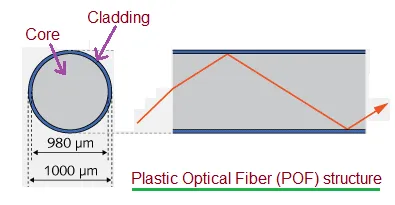
- Using Polystyrene (PS) as the core material (refractive index ≈ 1.59) and Polymethyl methacrylate (PMMA) as the cladding material (refractive index ≈ 1.49) yields excellent results for plastic fiber. PMMA offers better mechanical properties and high resistance to degradation or chemical attack. PS offers relatively less absorption loss compared to other polymeric materials.
- Figure 1 (above) illustrates the basic structure of a plastic fiber.
- All-plastic fibers are best suited for short distances (< 100 meters) and low signal transmission (~ few Mbps) systems. They also find applications as all-plastic strain sensors and acoustic sensors. They are primarily used in the medical and automotive industries.
Benefits or Advantages of Plastic Fiber
- Lower Costs: Production and packaging costs are lower compared to glass optical fiber.
- Flexibility: POF is soft and non-brittle, allowing for greater bending without cracking. It can even be cut with a regular razor.
- Immunity to Noise: It doesn’t emit any radiation and is immune to noise, so it can be run alongside power cables without interference.
- Ruggedness and Ease of Installation: More rugged and flexible than glass, making it easier to install.
- Lightweight: Significantly lighter than glass fibers.
- Stress Resistance: Can withstand a fair amount of stress.
Drawbacks or Disadvantages of Plastic Fiber
- High Attenuation and Dispersion: Signal attenuation and dispersion are very high, making them unsuitable for long-distance communication systems.
- Temperature Sensitivity: The refractive index of the core and cladding changes rapidly at higher temperatures, affecting the Numerical Aperture (NA) and mode pattern.
- Lower Quality: Generally offers lower performance compared to glass optical fiber.
- Flammability: It’s flammable and should be used in selected applications only after careful analysis of safety considerations.
Summary
Plastic Optical Fiber (POF) transmits light through flexible polymer fibers for short-distance communication. It offers easy installation, low cost, and high resistance to electromagnetic interference.
Continue Learning Fiber Optic Fundamentals & Tutorials
- Understanding Optical Fiber Communication
- Understanding Plastic Optical Fiber
- Fiber Optic Sensors: Types, Working Principles & Applications
- RF Over Fiber: Advantages, Disadvantages & Key Differences
- THz to Optical Conversion in 6G Wireless
- Quantum Key Distribution Over Fiber
- Optical Circuit Switching vs Burst Switching vs Packet Switching
Technology Comparisons (Fiber vs. Others)
- Fiber vs Microwave
- Copper vs Fiber Optic Cable Comparison
- Glass Optical Fiber vs Plastic Optical Fiber (GOF vs POF)
- Active vs Passive Optical Networks (AON vs PON)
- 5G vs Fiber Optic
Explore More Optical Networking Components
- Optical Switching Basics
- Optical Transceiver Explained
- Optical Add-Drop Multiplexer (OADM) Explained
- What is a ROADM (Reconfigurable Optical Add-Drop Mux)?
- Optical Fiber Connectors (FC, SC, ST, LC, DIN)
- Optical Amplifiers & Repeaters
- Optical Wavelength Converters
- Optical Filter Basics
- Optical Equalizer Basics
- Optical Transimpedance Amplifier
- Optical Sensors: Advantages & Disadvantages
- Optical Biosensors: Working, Types & Applications