
Fiber Dispersion: Material, Modal, and Waveguide Types
Advertisement
This article explains the fundamentals of fibre dispersion and explores different types of dispersion, including material dispersion, modal dispersion, and waveguide dispersion.
Dispersion occurs when a pulse of light spreads as it travels through an optical fibre cable.
When a pulse (let’s call it ‘A’) is transmitted through the fibre, it elongates. This can cause it to merge with the pulse following behind it (‘A’), making it difficult to recover the original bitstream.
In digital optical communication, a ‘1’ is represented by “light,” and a ‘0’ is represented by “no light” or “darkness.” In analog optical communication, information is conveyed as a continuous series of changes in the analog signal. Therefore, in analog communication, dispersion leads to distortion.
There are several types of dispersion. Here are the main ones:
- Material dispersion
- Modal dispersion
- Waveguide dispersion
Material Dispersion
Material dispersion arises from the inherent properties of the fibre material, specifically its refractive index. Different fibre materials have different refractive indices. This means that different wavelengths of light travel at varying speeds within different fibre types.
As a result, some wavelength pulses arrive earlier than others, causing the signal pulse to disperse or smear out.
Modal Dispersion
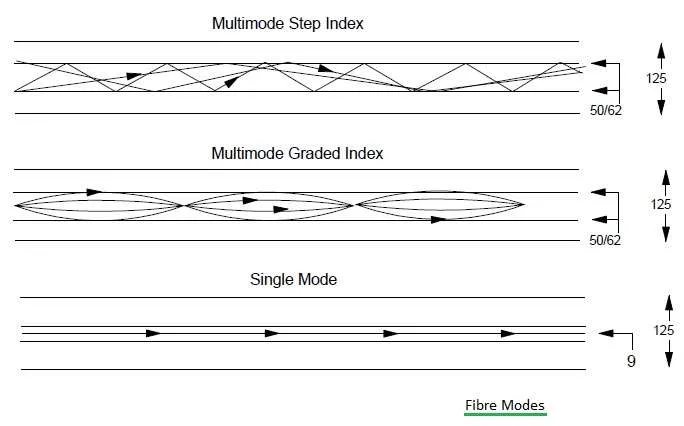
Modal dispersion is caused by the different modes present in the fibre cable. Light travels through different paths in different modes. This results in varying travel distances for light in different modes, leading to dispersion.
Waveguide Dispersion
Waveguide dispersion is influenced by the shape and index profile of the fibre core. It can be managed through careful design. This type of dispersion can also help to offset the effects of material dispersion, as mentioned above.
Continue Learning Fiber Optic Fundamentals & Tutorials
- Understanding Optical Fiber Communication
- Understanding Plastic Optical Fiber
- Fiber Optic Sensors: Types, Working Principles & Applications
- RF Over Fiber: Advantages, Disadvantages & Key Differences
- THz to Optical Conversion in 6G Wireless
- Quantum Key Distribution Over Fiber
- Optical Circuit Switching vs Burst Switching vs Packet Switching
Technology Comparisons (Fiber vs. Others)
- Fiber vs Microwave
- Copper vs Fiber Optic Cable Comparison
- Glass Optical Fiber vs Plastic Optical Fiber (GOF vs POF)
- Active vs Passive Optical Networks (AON vs PON)
- 5G vs Fiber Optic
Explore More Optical Networking Components
- Optical Switching Basics
- Optical Transceiver Explained
- Optical Add-Drop Multiplexer (OADM) Explained
- What is a ROADM (Reconfigurable Optical Add-Drop Mux)?
- Optical Fiber Connectors (FC, SC, ST, LC, DIN)
- Optical Amplifiers & Repeaters
- Optical Wavelength Converters
- Optical Filter Basics
- Optical Equalizer Basics
- Optical Transimpedance Amplifier
- Optical Sensors: Advantages & Disadvantages
- Optical Biosensors: Working, Types & Applications