
Key Optical Components in Fiber Optic Systems
Advertisement
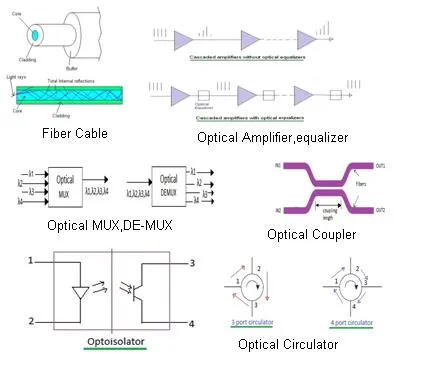
This page describes the function of various optical components and lists manufacturers/vendors. It covers essential components like transmitters, detectors, optical couplers, isolators, circulators, switches, amplifiers, filters, equalizers, connectors, multiplexers, de-multiplexers, and more.
Optical Transmitter
The optical transmitter converts an information signal into a light signal suitable for transmission over a fiber optic cable. LEDs and lasers are commonly used for this purpose.
Optical Detector
The optical detector converts light waves into a form that can be interpreted by the user. Photodiodes are typically used to achieve this conversion.
Optical Coupler
An optical coupler directs or routes the light signal to the desired location, whether for measurement purposes or as an input for another process.
Optical Isolator
This optical component allows light to pass in one direction while blocking it in the opposite direction.
Optical Circulator
Similar to an isolator, an optical circulator has three ports. They are available in clockwise and counter-clockwise configurations. They are primarily used to create bi-directional optical fiber links.
Optical Switches
Optical switches have a wide range of applications. One key use is routing traffic to a secondary, standby optical fiber in the event of a failure in the primary fiber optic cable.
Optical Amplifier
This component amplifies the optical signal, either directly or by converting it into an electrical signal and then back to optical.
Filter
An optical filter selectively allows desired signals to pass through while rejecting unwanted optical signals.
Equalizer
An equalizer balances the gain of different wavelength optical signals, making it possible to cascade amplifier stages.
Optical Multiplexer/De-multiplexer
This component multiplexes (combines) and de-multiplexes (separates) signals. Multiplexing enables high bandwidth optical signals. De-multiplexing results in smaller bandwidth optical signals.
Optic Connectors
Various types of connectors are used in fiber optic communication systems to perform different functions.
Continue Learning Fiber Optic Fundamentals & Tutorials
- Understanding Optical Fiber Communication
- Understanding Plastic Optical Fiber
- Fiber Optic Sensors: Types, Working Principles & Applications
- RF Over Fiber: Advantages, Disadvantages & Key Differences
- THz to Optical Conversion in 6G Wireless
- Quantum Key Distribution Over Fiber
- Optical Circuit Switching vs Burst Switching vs Packet Switching
Technology Comparisons (Fiber vs. Others)
- Fiber vs Microwave
- Copper vs Fiber Optic Cable Comparison
- Glass Optical Fiber vs Plastic Optical Fiber (GOF vs POF)
- Active vs Passive Optical Networks (AON vs PON)
- 5G vs Fiber Optic
Explore More Optical Networking Components
- Optical Switching Basics
- Optical Transceiver Explained
- Optical Add-Drop Multiplexer (OADM) Explained
- What is a ROADM (Reconfigurable Optical Add-Drop Mux)?
- Optical Fiber Connectors (FC, SC, ST, LC, DIN)
- Optical Amplifiers & Repeaters
- Optical Wavelength Converters
- Optical Filter Basics
- Optical Equalizer Basics
- Optical Transimpedance Amplifier
- Optical Sensors: Advantages & Disadvantages
- Optical Biosensors: Working, Types & Applications