
Extrinsic vs. Intrinsic Optical Sensors: Key Differences
Advertisement
This article highlights the key differences between extrinsic and intrinsic optical sensors. Optical fiber sensing relies on variations within a light beam. These changes can occur either outside or inside the fiber optic cable, leading to two distinct sensor types: extrinsic and intrinsic.
Extrinsic Optical Sensor
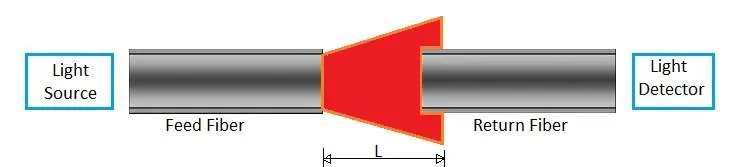 Fig-1: Extrinsic Optical Sensor
Figure 1 illustrates an extrinsic optical sensor. In this configuration, the light beam exits the fiber cable and is altered by an external object before reaching the optical detector. This type of sensor can be used to measure parameters such as distance (L), as shown in the diagram.
Intrinsic Optical Sensor
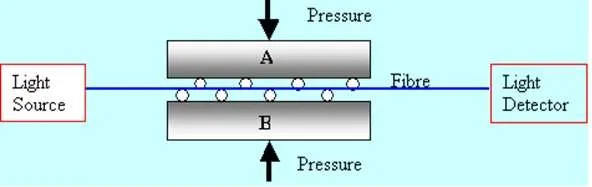 Fig-2: Intrinsic Optical Sensor
Figure 2 depicts an intrinsic optical sensor. Unlike extrinsic sensors, the light beam does not exit the fiber cable. Instead, the light is modulated within the cable itself. As an example, the diagram illustrates how pressure applied between two plates can alter the light beam’s properties, enabling pressure measurement.
Extrinsic vs. Intrinsic Optical Sensors: Key Differences
The following table summarizes the similarities and differences between extrinsic and intrinsic optical sensors:
| Feature | Extrinsic Optical Sensors | Intrinsic Optical Sensors |
|---|---|---|
| Applications | Temperature, pressure, liquid level, flow | Rotation, acceleration, strain, acoustic pressure, vibration |
| Sensitivity | Less sensitive | More sensitive |
| Multiplexing | Easy to multiplex | Difficult to multiplex |
| Connection Issues | Prone to connection problems at entry/exit points | Fewer connection-related problems |
| Ease of Use | Easier to use in various applications | Requires more elaborate signal demodulation |
| Cost | Less expensive | More expensive |
Continue Learning Fiber Optic Fundamentals & Tutorials
- Understanding Optical Fiber Communication
- Understanding Plastic Optical Fiber
- Fiber Optic Sensors: Types, Working Principles & Applications
- RF Over Fiber: Advantages, Disadvantages & Key Differences
- THz to Optical Conversion in 6G Wireless
- Quantum Key Distribution Over Fiber
- Optical Circuit Switching vs Burst Switching vs Packet Switching
Technology Comparisons (Fiber vs. Others)
- Fiber vs Microwave
- Copper vs Fiber Optic Cable Comparison
- Glass Optical Fiber vs Plastic Optical Fiber (GOF vs POF)
- Active vs Passive Optical Networks (AON vs PON)
- 5G vs Fiber Optic
Explore More Optical Networking Components
- Optical Switching Basics
- Optical Transceiver Explained
- Optical Add-Drop Multiplexer (OADM) Explained
- What is a ROADM (Reconfigurable Optical Add-Drop Mux)?
- Optical Fiber Connectors (FC, SC, ST, LC, DIN)
- Optical Amplifiers & Repeaters
- Optical Wavelength Converters
- Optical Filter Basics
- Optical Equalizer Basics
- Optical Transimpedance Amplifier
- Optical Sensors: Advantages & Disadvantages
- Optical Biosensors: Working, Types & Applications