
FSK Modulation Implementation in Python
Advertisement
This document provides Python code for Frequency Shift Keying (FSK) modulation. The script generates an FSK modulated waveform and a binary data waveform as output.
Introduction to FSK
FSK stands for Frequency Shift Keying. It’s a digital modulation scheme where digital data (binary 0s and 1s) are represented by different carrier frequencies. Binary 1 is represented by one frequency (f1), and binary 0 is represented by another frequency (f2).
In the provided Python script, f1 is set to 45 Hz, and f2 is set to 30 Hz. The script uses a separate Binarygen.py script to generate random binary data.
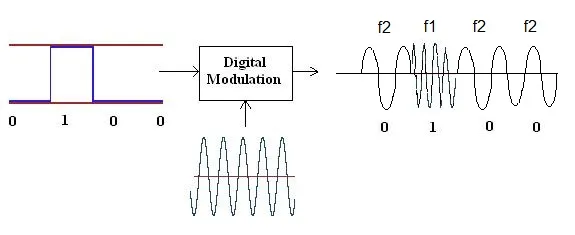
Binary FSK can be represented by the following equations:
Binary Data Generator (Binarygen.py)
The following Python script generates random binary data, used as the baseband data for FSK modulation.
def binary(sym, sym_len):
    import numpy as np
    rand_n = np.random.rand(sym)
    rand_n[np.where(rand_n >= 0.5)] = 1
    rand_n[np.where(rand_n <= 0.5)] = 0
    sig = np.zeros(int(sym*sym_len)) # generating symbols
    id1 = np.where(rand_n == 1)
    for i in id1[0]:
        temp = int(i*sym_len)
        sig[temp:temp+sym_len] = 1
    return sig
FSK Python Script
The following FSK Python script generates an FSK modulated waveform for random binary data input.
# This python script generates FSK modulated waveforms
# Library files
import matplotlib.pyplot as plt
import numpy as np
from Binarygen import binary
from math import pi

plt.close('all')

# Carrier wave and binary signal configuration parameters
Fs = 1000  # Samples per second
fc = 30    # Carrier frequency 30 Hz, 30 cycles/sec
T = 1      # Total simulation time in seconds, 1sec
t = np.arange(0, T, 1/Fs)
Td = 0.1   # Bit duration
Nsamples = int(Td*Fs) # Samples in one bit duration
Nsym = int(np.floor(np.size(t)/Nsamples))

# Binary waveform generation
sig = binary(Nsym,Nsamples)

# FSK waveform generation
f = fc + fc*sig/2
Xfsk = np.sin(2*pi*f*t)

# Binary waveform and FSK modulation waveform Plots
figure, axis = plt.subplots(2)
axis[0].plot(t, sig)
axis[0].set_title("Binary digital data")
axis[1].plot(t, Xfsk, 'r')
axis[1].set_title("FSK modulated signal")
plt.tight_layout()
plt.show()
Output Plots
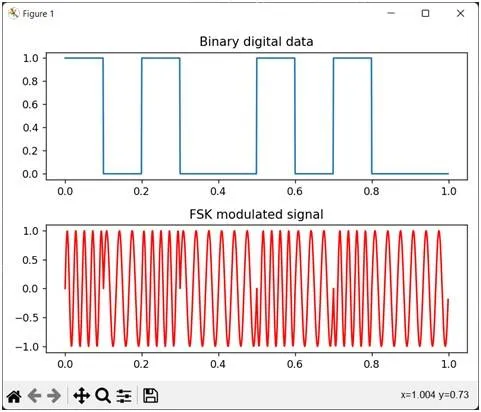
The following are the output plots (Binary input data and FSK modulated waveform) generated by the FSK modulation Python script.
Continue Learning FSK Fundamentals & Comparisons
- FSK Modulation: Types and Applications (App Note)
- FSK: Advantages and Disadvantages
- ASK, FSK, PSK Digital Modulation Techniques
- OOK vs FSK vs ASK Modulation: Understanding the Differences
- M-FSK: Advantages and Disadvantages
- 2FSK vs 4FSK: Understanding the Differences
Explore GFSK & MSK Modulation (Advanced FSK Variants)
- GFSK vs FSK: What’s the Difference?
- GFSK vs GMSK: Key Differences
- GFSK Modulation: Advantages & Disadvantages
- MSK / GMSK Modulation Techniques
- MSK / GMSK: Advantages & Disadvantages
- QPSK vs MSK: Understanding the Differences