
What is M-FSK : Multiple Frequency Shift Keying Advantages and Disadvantages
Advertisement
M-FSK (Multiple Frequency Shift Keying) is a digital modulation technique that represents data using multiple discrete carrier frequencies. It is used in telemetry, radio communication, and low-power wireless systems. Advantages include improved noise immunity and reliability, while disadvantages include increased bandwidth requirements and lower spectral efficiency.
M-FSK Modulation Data Mapping
M-FSK (M-array FSK) is a variant of binary FSK, which utilizes two distinct tones. The following equations dictate how binary data is mapped in FSK (Frequency Shift Keying):
- s(t) = A * cos(2 * π * f1 * t) for Binary 1
- s(t) = A * cos(2 * π * f2 * t) for Binary 0
Here, ‘f1’ and ‘f2’ represent frequencies offset from the center frequency employed in the system.
The image below illustrates FSK modulation waveforms for binary 1 and binary 0 data.
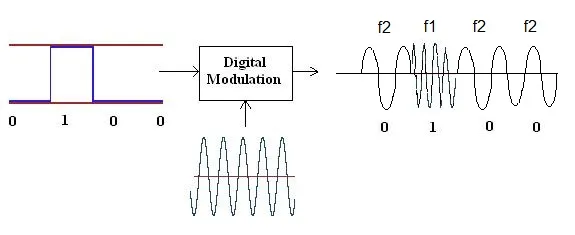
There exists a variety of M-ary modulation techniques, including M-ary PSK, M-ary QAM, and M-ary FSK. In these techniques, digital data is transmitted by modulating the envelope, phase, or frequency of an RF carrier. These techniques map baseband digital data onto four or more RF carriers, earning them the designation “M-ary modulation.”
M-FSK Mathematical Formula
MFSK uses multiple frequency tones to represent digital data before transmission. It employs narrow tone spacing to achieve higher data rates within a given bandwidth. The generalized equation for MFSK can be expressed as:
Xi(t) = A * cos (2 * π * fi * t)
Where:
- fi = fc + (2 * i - 1 - M) * fd
- fi is the frequency of the i-th signal
- fc is the center frequency
- fd is the frequency deviation
- M is the Modulation order (number of possible signals) (e.g., M = 2 for BPSK, M = 4 for QPSK)
The number of bits/symbol, K, is calculated as:
K = log2(M)
For instance, in 4FSK with a center frequency (fc) of 250 KHz and a frequency deviation (fd) of 25 KHz, we obtain 2 bits per symbol because M equals 4. The four frequencies used to map binary data (00, 01, 10, 11) are 175 KHz, 225 KHz, 275 KHz, and 325 KHz.
Typical applications of M-FSK include VHF/UHF communication, telephone signaling (DTMF), Digital Mobile Radio (DMR), and Bluetooth (FHSS).
Advantages of MFSK
MFSK addresses some of the limitations of BFSK (Binary FSK or 2FSK) modulation.
Following are the benefits of MFSK:
- Reduced Error Rate: The increased number of frequency tones leads to a lower error rate.
- Noise Rejection: MFSK effectively rejects broadband noise and pulses at the receiver.
- Tolerance to Channel Effects: It is less susceptible to ionospheric channel effects like Doppler shift, multipath propagation, and fading.
- Robustness: MFSK is generally more robust than PSK modulation schemes.
Drawbacks or Disadvantages of MFSK
- Complex Tuning: Tuning at the receiver is more complex due to the narrow bandwidth and spacing of individual tone detectors.
- Stability Requirements: Lower Tx/Rx offset and good stability of the transceiver module are essential.
- Bandwidth Usage: MFSK utilizes more bandwidth compared to PSK modulation for the same data rate.
Summary
M-FSK modulation improves communication reliability through multiple frequency states. Advantages include better noise resistance, while disadvantages include greater bandwidth consumption and reduced spectrum efficiency.
Continue Learning FSK Fundamentals & Comparisons
- FSK Modulation: Types and Applications (App Note)
- FSK: Advantages and Disadvantages
- ASK, FSK, PSK Digital Modulation Techniques
- OOK vs FSK vs ASK Modulation: Understanding the Differences
- 2FSK vs 4FSK: Understanding the Differences
Explore GFSK & MSK Modulation (Advanced FSK Variants)
- GFSK vs FSK: What’s the Difference?
- GFSK vs GMSK: Key Differences
- GFSK Modulation: Advantages & Disadvantages
- MSK / GMSK Modulation Techniques
- MSK / GMSK: Advantages & Disadvantages
- QPSK vs MSK: Understanding the Differences