
What are MSK and GMSK : Advantages and Disadvantages
Advertisement
MSK (Minimum Shift Keying) and GMSK (Gaussian Minimum Shift Keying) are continuous-phase digital modulation techniques used in wireless communication systems. They provide high spectral efficiency, reduced interference, and constant envelope transmission. However, receiver complexity and synchronization requirements can increase implementation challenges in practical communication networks.
What are MSK and GMSK?
MSK and GMSK are types of frequency-shift keying (FSK) modulation. GMSK is actually derived from the basic MSK scheme.
Standard Phase Shift Keying (PSK) modulation has sidebands that extend out from the carrier frequency. MSK and GMSK were developed to address this issue.
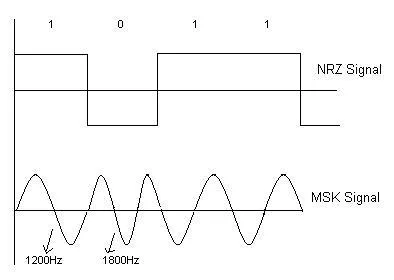
MSK is a type of FSK modulation that occupies less bandwidth, reducing interference. It uses a half cycle of a sine wave for each symbol. When you apply a Gaussian filter to MSK, you get a GMSK signal.
For a deeper dive, refer to resources that explain the basics of MSK and GMSK.
Benefits (Advantages) of MSK and GMSK
- Reduced Sideband Power: These techniques minimize the sidebands of the PSK modulated spectrum, leading to reduced sideband power.
- Good Signal-to-Noise Ratio (SNR): MSK and GMSK are less affected by noise, resulting in a good SNR. This is crucial for stable, long-distance communication. It’s why GMSK is used in GSM technology.
- Improved Receiver Sensitivity: The good SNR translates to better receiver sensitivity.
- Low Peak-to-Average Power Ratio (PAPR): Phase continuities are avoided, and frequency changes occur at zero crossings of the RF carrier, keeping PAPR low. This means you don’t need a highly linear power amplifier (PA).
- Spectral Efficiency: They offer better spectral efficiency with a less complex demodulator.
- Constant Envelope (GMSK): GMSK maintains a constant envelope across the entire bandwidth, providing excellent power efficiency.
- Good Bit Error Rate (BER) Performance: They provide solid BER performance.
- Self-Synchronization (GMSK): GMSK has self-synchronizing capabilities.
- Good for Voice Modulation: GMSK is a great choice for voice modulation.
Drawbacks (Disadvantages) of MSK and GMSK
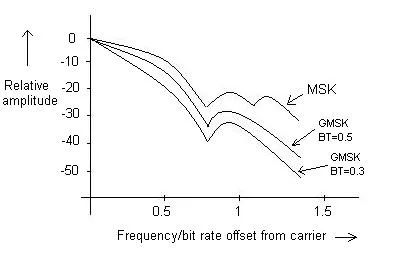
- Adjacent Channel Interference (MSK): The power spectral density (PSD) of MSK doesn’t fall off quickly, which can lead to interference between adjacent channels. GMSK, using a BT of 0.3 (where B is the 3dB bandwidth of the shaping filter and T is the bit duration), helps achieve better rejection between adjacent channels.
- Higher Power Requirement: MSK and GMSK require more power to transmit data compared to other modulation types like QPSK.
- Complex Channel Equalization: They require complex channel equalization algorithms, such as an adaptive equalizer at the receiver.
- Inter-Symbol Interference (ISI): Inter-symbol interference can occur.
Summary
MSK and GMSK modulation techniques improve bandwidth efficiency and signal robustness in wireless systems. Learn the advantages and disadvantages of MSK and GMSK, including low spectral sidelobes, constant envelope operation, and receiver design complexity.
Continue Learning MSK & GMSK
Continue Learning Modulation Types
- AM Vs. FM Vs. PM : Difference between Analog Modulation Techniques
- ASK Vs. FSK Vs. PSK : Difference between Digital Modulation Techniques
- PAM Vs. PWM Vs. PPM : Difference between Pulse Modulation Techniques
- BPSK Vs. QPSK : Key Differences
- 16-QAM Vs. 64-QAM Vs. 256-QAM : Key Differences
- 512-QAM Vs. 1024-QAM Vs. 2048-QAM Vs. 4096-QAM
- 4096QAM Modulation Used in Wi-Fi 7
- MSK Vs. GMSK : Modulation Technique used in GSM
- LORa Modulation Used in LoRaWAN
- 10% ASK & 100% ASK Modulation used in NFC
- OOK Vs. VPPM Vs. CSK : Visible Light Communication (VLC) Modulation Techniques
- QPSK Vs. OQPSK Vs. PI/4 QPSK
- PAM4 Modulation Used in Gigabit Ethernet
- CCK Vs. DSSS Vs. OFDM Used in WLAN (Wi-Fi) Standards