
What is GFSK Modulation : Advantages and Disadvantages
Advertisement
Gaussian Frequency Shift Keying (GFSK) is a digital modulation technique that smooths frequency transitions using a Gaussian filter before modulation. It is widely used in Bluetooth, IoT, and wireless communication systems. Advantages include reduced bandwidth usage and improved spectral efficiency, while disadvantages include increased receiver complexity and potential signal distortion.
Key Features of GFSK Modulation
- It’s a form of Frequency Shift Keying (FSK), a modulation technique where the carrier frequency is shifted to represent different symbols or bits.
- It’s characterized by using a Gaussianfilter to shape the frequency pulses.
- This pulse shaping reduces the side lobes of the transmitted signal, improving spectral efficiency.
- This modulation scheme is employed in communication systems for transmitting digital data over radio frequency channels.
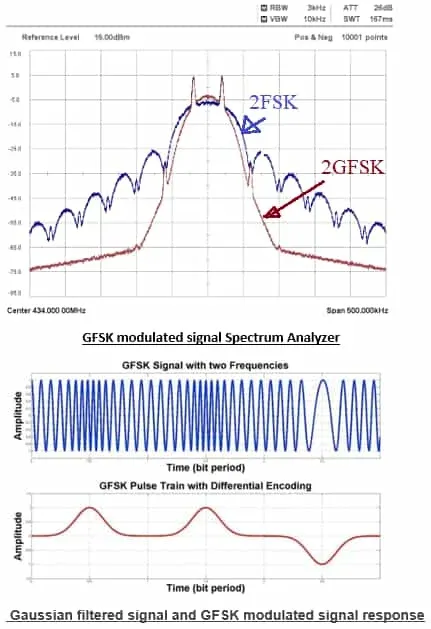
The figure-1 depicts FSK and GFSK modulated spectrums and time waveforms.
Advantages of GFSK
Here are the benefits of using GFSK:
- Improved Spectral Efficiency: Compared to traditional FSK, GFSK offers improved spectral efficiency thanks to the use of Gaussian filtering. This helps reduce side lobes, allowing for more efficient use of available bandwidth.
- Narrower Bandwidth Occupancy: The spectral shaping provided by GFSK results in a narrower bandwidth occupancy. This is advantageous in systems where bandwidth is limited or expensive.
- Reduced Intersymbol Interference (ISI): GFSK is less susceptible to intersymbol interference, a phenomenon where symbols transmitted close in time interfere with each other. The Gaussian filtering helps in shaping the pulses and reducing ISI.
- Wide Applicability: GFSK is commonly used in various digital communication systems, including Bluetooth and certain WLANs, making it well-suited for modern digital communication applications.
- Simpler Receiver Design: The receiver for GFSK-modulated signals can be simpler compared to more complex modulation schemes, offering advantages in terms of implementation and cost.
Disadvantages of GFSK
Here are the drawbacks of using GFSK:
- Non-Constant Amplitude: GFSK doesn’t maintain a constant amplitude. The amplitude of the modulated signal can vary based on the data being transmitted.
- Unsuitable for Constant Envelope Applications: In applications where a constant envelope is crucial, such as in some mobile communication systems, GFSK may not be the ideal choice. Constant envelope modulation schemes like GMSK are often preferred in such cases.
- Sensitivity to Noise: Like other modulation schemes, GFSK is sensitive to noise, and its performance can degrade in the presence of significant noise or interference.
- Limited Range: GFSK is more commonly used in short-range communication systems, and its use may be limited in scenarios where other modulation schemes provide better performance over longer distances.
- Lower Power Efficiency (Potentially): GFSK modulation may not be as power-efficient as constant envelope modulation schemes, especially in applications where power consumption is a critical consideration.
Summary
GFSK modulation improves spectral efficiency by filtering frequency transitions. Advantages include reduced interference and bandwidth requirements, while disadvantages include added complexity and performance trade offs.
Continue Learning FSK Fundamentals & Comparisons
- FSK Modulation: Types and Applications (App Note)
- FSK: Advantages and Disadvantages
- ASK, FSK, PSK Digital Modulation Techniques
- OOK vs FSK vs ASK Modulation: Understanding the Differences
- M-FSK: Advantages and Disadvantages
- 2FSK vs 4FSK: Understanding the Differences
Explore GFSK & MSK Modulation (Advanced FSK Variants)
- GFSK vs FSK: What’s the Difference?
- GFSK vs GMSK: Key Differences
- MSK / GMSK Modulation Techniques
- MSK / GMSK: Advantages & Disadvantages
- QPSK vs MSK: Understanding the Differences