
Antenna Pattern: Beam Squint and Sector Power Ratio
Advertisement
This page covers antenna pattern beam squint and sector power ratio, and provides a comparison between horizontal pattern beam squint and sector power ratio.
Antenna Beam Squint
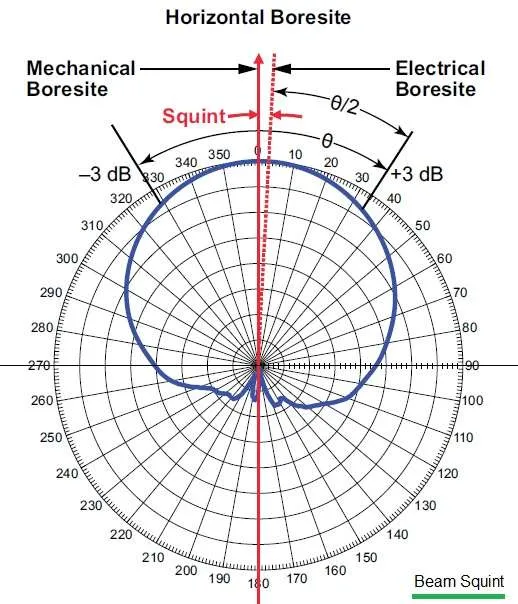
Beam squint is defined as the difference between the mechanical boresite and the electrical boresite of an antenna, as illustrated in Figure 1. The mechanical boresite is defined as being perpendicular to the antenna’s back tray, while the electrical boresite is defined as the midpoint of the 3 dB beamwidth.
Antenna Sector Power Ratio
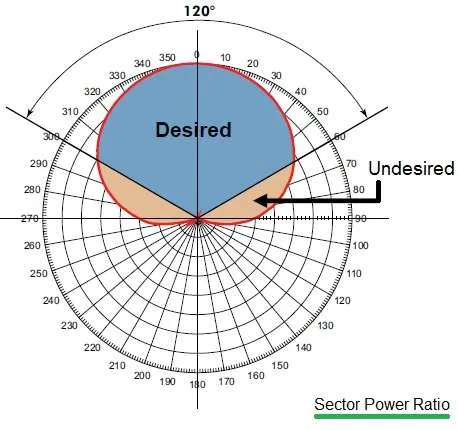
Sector Power Ratio (SPR) is another measure of an antenna’s ability to minimize interference. It represents the ratio of RF power radiated outside the sector to the RF power radiated and retained within the sector.
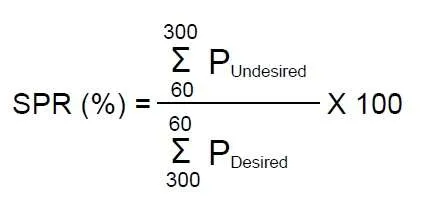
High-performing antenna designs typically achieve SPRs of 3% to 4%, whereas designs using dipole or patch elements typically yield an SPR of approximately 8%. The sector power ratio equation is shown above.
Continue Learning About Antenna Technology
- Antenna Basics Tutorial
- Antenna Related Terms
- Antenna mechanical Vs. electrical tilt
- Difference between antenna gain directivity efficiency
- Antenna gain & effective area
- Bandwidth Vs. beamwidth antenna difference
- Antenna Factor
- Near field Vs. Far field antenna radiation pattern
Explore Different Types of Antennas
-
Check-out: Guide to List of Antenna Types >>