
What is Holographic Beamforming Antennas : Advantages and Disadvantages
Advertisement
Holographic beamforming antennas use advanced electromagnetic surface structures to electronically steer and shape radio beams without relying on complex phased-array architectures. They are being explored for 5G, 6G, satellite, and defense applications. Advantages include lower power consumption and compact design, while disadvantages include implementation complexity and limited commercial maturity.
Features of Holographic Beamforming Antenna
A holographic beamforming antenna is a technology that employs holographic techniques to manipulate electromagnetic (EM) waves, generating beams of energy. These beams are directed to different locations, providing wireless signals to mobile users.
Holographic antennas can handle multiple tasks, including beamforming, polarization conversion, and frequency filtering, all within a single device. These antenna systems rely on holographic metasurfaces to shape and manipulate the electromagnetic waves.
This approach promises several benefits, like higher data rates, increased energy efficiency, and improved coverage.
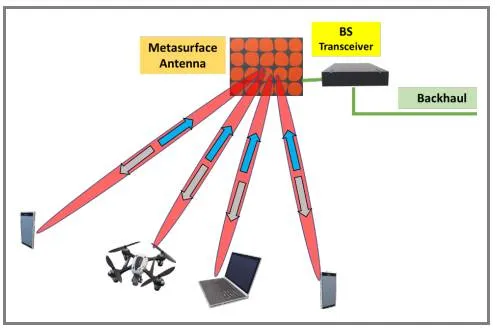 Holographic Beamforming Antenna
This concept can be realized in two primary ways: using passive reflective metasurfaces or employing active transceiver antenna arrays (as shown in the image).
Benefits or Advantages of Holographic Beamforming Antennas
- Precise Beam Steering: Creates beams of energy in desired directions with high precision. This beam steering capability leads to more efficient use of available bandwidth.
- Wide Range of Applications: Can be used for a wide range of wireless systems.
- Dynamic Beam Creation and Steering: Unlike traditional antennas, these antennas can dynamically create and steer beams. This adaptability is beneficial in changing environmental conditions and varying signal requirements.
- Low Power Consumption: Can be designed to operate at low power levels, which reduces power consumption and extends battery life in wireless devices.
- Reduced Interference: Narrow and precisely directed beams of energy using beam steering can reduce interference with other wireless transmissions.
- Compact and Lightweight: Holographic antennas are designed to be thin, lightweight, and conformal. This allows for integration into various devices, such as wearables and IoT devices.
Drawbacks or Disadvantages of Holographic Beamforming Antennas
- Complexity: More complex compared to traditional antenna technologies. It requires advanced signal processing and control algorithms to create and steer beams in desired directions.
- Cost: More expensive to manufacture and install.
- Short Range Communication: Designed to provide short-range communication.
- Bandwidth Limitations: Bandwidth is limited by the number of antenna elements, which limits its ability to support high data rate applications.
Summary
Holographic beamforming antennas enable efficient electronic beam steering for next-generation wireless networks. Advantages include reduced hardware complexity and energy efficiency, while disadvantages include design challenges and emerging technology limitations.
Continue Learning Beamforming Fundamentals, Types & Comparisons
- Beamforming: Advantages and Disadvantages
- Active vs Passive Beamforming
- Analog vs Digital Beamforming
- Single-User vs Multi-User Beamforming (SU-MIMO vs MU-MIMO)
- Analog, Digital & Hybrid Beamforming Basics and Types
- Hybrid Beamforming: Advantages & Disadvantages
Beamforming in Wi-Fi, 5G & 6G Networks
- WLAN 802.11ac Beamforming Tutorial
- Phased Array Beamforming IC for 5G : Popular Manufacturers
- Traditional vs Secure Beamforming in 6G Networks
Continue Learning 6G Wireless Technology : Building Blocks of 6G
- 6G Wireless Network Basics Tutorial
- 6G Network Architecture & its interfaces
- 6G Core Technologies
- Reconfigurable Intelligent Surfaces (RIS) in 6G
- AI Native in 6G Wireless Networks
- JCAS or ISAC - Integrated Sensing and Communication in 6G
- CoMP & RIS : Security in 6G
- RF Fingerprinting in 6G
- Physical Layer Security in 6G
- What is Autoencoder in 6G
- What is OAM Multiplexing in 6G
- What is OTFS Waveform in 6G
- MAC Layer Security Concepts in 6G