
Antenna Gain vs Directivity vs Efficiency: Key Differences
Advertisement
Antenna gain, directivity, and efficiency are three fundamental parameters used to evaluate the performance of RF and microwave antennas. Although these terms are closely related, they describe different characteristics of an antenna’s ability to radiate or receive electromagnetic energy. Understanding the difference between antenna gain, directivity, and efficiency helps engineers select and design antennas for applications such as cellular networks, satellite communication, radar, Wi-Fi, IoT, and wireless test systems.
Antenna Directivity
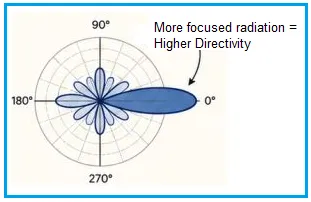
It is a measure of how well an antenna concentrates its radiated energy in a specific direction compared to a theoretical isotropic antenna (an antenna that radiates equally in all directions, like a perfect sphere).
It describes the shape of the radiation pattern. An antenna with high directivity has a narrow, highly focused beam, whereas one with low directivity spreads energy over a wider area.
Analogy in real-life : It can be compared with use of reflector inside flashlight. As we know, reflector simply takes available light and focuses it into directed beam.
Antenna Efficiency
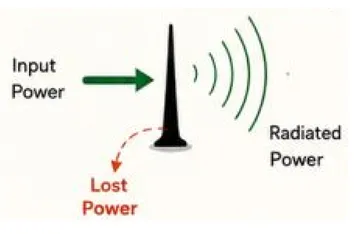
It measures how effectively the antenna converts the electrical power fed into it (i.e. input power) into actual radio frequency energy traveling through space (i.e. radiated power).
In real world, no antenna is perfect and some of the input power is inevitably lost as heat due to physical and electrical imperfections.
The formula for antenna efficiency can be mentioned as follows.
Analogy : A highly efficient falshlight converts most of the battery’s energy into light, losing very little to heat.
Antenna Gain
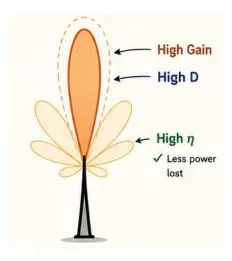
It represents overall performance of the antenna in a given direction under real-world conditions. Gain combines both antenna’s ability to focus energy (i.e. directivity) and its ability to convert input power to radiated power without losses (i.e. efficiency).
The formula which provides relation between these three antenna terms is as follows.
Analogy : Gain is the actual brightness of the flashlight beam which hits the wall. It requires good reflector (i.e. directivity) and efficient bulb with battery system (i.e. efficiency)
Difference between Antenna directivity, efficiency and gain
| Feature | Directivity | Efficiency | Gain |
|---|---|---|---|
| Definition | How well the antenna focuses its radiated energy. | How effectively the antenna converts input power into radiated power. | The overall strength and performance of the signal in a specific direction. |
| What is tells us | Where the power goes (Radiation Pattern). | How much power is successfully used vs. lost. | The real outcome combining both focus and power conservation. |
| Formula | Depends on angular radiation intensity (U) vs average intensity. | Equals ratio of radiated power to input power | Equals multiplication of directivity and efficiency |
| Accounts for losses | No, it assumes perfect and lossless antenna | Yes, it is specifically measure of those internal losses. | Yes, it factors in efficiency, reflecting real world performance. |
| Flashlight analogy | The shape of the reflector focusing the light. | The battery and bulb converting energy with minimal heat loss. | The final, visible brightness of the beam you actually see. |
Summary
Directivity indicates how well an antenna concentrates radiated energy in a specific direction, efficiency represents power conversion effectiveness, and gain combines both characteristics. Together, these parameters determine the real-world performance of an antenna.
Continue Learning About Antenna Technology
- Antenna Basics Tutorial
- Antenna Related Terms
- Antenna mechanical Vs. electrical tilt
- Antenna gain & effective area
- Bandwidth Vs. beamwidth antenna difference
- Antenna Factor
- Near field Vs. Far field antenna radiation pattern
Explore Different Types of Antennas
-
Check-out: Guide to List of Antenna Types >>