
What is 5G Antenna Radome & its material: Top Manufacturers
Advertisement
A 5G antenna radome is a protective enclosure that shields antennas from environmental factors such as rain, UV exposure, dust, wind and temperature fluctuations while allowing radio frequency signals to pass with minimal attenuation. Common radome materials include fiberglass reinforced composites, PTFE, polycarbonate, ABS and advanced low loss dielectric materials optimized for 5G network performance. Top manufacturers are Pacific Radomes Inc., Infinite Technologies Incorporated and Diab Group. 5G radomes are essential for protecting antennas from environmental factors while maintaining signal integrity.
What is Radome?
The protective enclosure around the antenna used to protect itself from harsh environments is known as radome. It attenuates EM signals during transmission and reception minimally. The radome used to protect 5G massive mimo antenna array is known as 5G antenna radome. 5G NR supports different frequency bands sub-6 GHz and above 6 GHz in mmwave region.
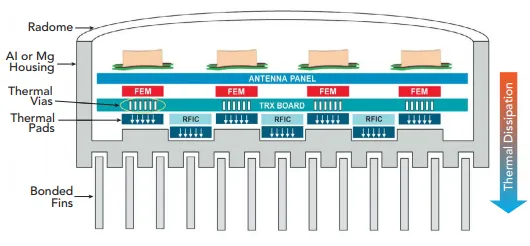
Image Courtesy : microwavejournal.com
The figure depicts cross section of radome around antenna panel housing antenna array along with other layers such as FEM (Front End Modules), RFICs and so on. Radome material should be anti-temperature, water proof, anti-aging and weather resistant.
Antenna Radome Material
Following materials are considered for antenna radome as per specifications.
- PVC, FRP and ASA are used for sub-6 GHz radome materials. These materials offer good mechanical, thermal and dielectric properties below 6 GHz. For these materials, dielectric losses increase significantly for mmwave frequencies and hence thickness of material is appropriately chosen to compensate for these losses.
- The other alternatives to radome materials include syntactic foams, prepregs or other composite constructions which perform better at high frequencies.
- Following table mentions selection of materials used for antenna radome.
| Material | Brand | Dielectric constant | Loss Tangent |
|---|---|---|---|
| Epoxy/Fiberglass | G10, FR4 | 4.9 | 0.0190 |
| Acetal | Delrin, Celon | 3.7 | 0.0050 |
| ABS | Lustran, Cycolac | 3.23 | 0.0200 |
| Nylon 6/6 | Zytel | 3.2 | 0.0210 |
| Polyetherimide | Ultem | 3.15 | 0.0013 |
| Polystyrene | Styron | 2.75 | 0.0005 |
| Polycarbonate | Lexan | 2.35 | 0.0100 |
| UHMWPE | Dyneema | 2.2 | 0.0004 |
Permittivity, loss tangent and radome material thickness must be selected carefully in conjunction with distance to antenna elements in order to enable optimal performance.
Antenna Radome manufacturers
Following table mentions manufacturers of Antenna Radome along with technical features.
| Antenna Radome Manufacturers | Description |
|---|---|
| Pacific Radomes Inc., Minden, NV 89423 | Manufacture lightweight composite radome structures for frequencies up to 100 GHz. |
| DOFRP, Japan, China, Vietnam | The company uses different materials to manufacture radome as per desired specifications. |
| Infinite Technologies Incorporated, CA 95762 | The company manufactures radomes and composite structures. The company provides services to manufacture radome as per specific requirements. Website : https://compositeradomes.com/ |
| Diab Group, Sweden | Website : https://www.diabgroup.com/ |
| Om Aakash Fibres, Mumbai, INDIA | Leading FRP/GRP antenna radome manufacturer Website : http://www.omaakashfrp.com/ |
Conclusion
5G antenna radomes are engineered using low loss RF transparent materials to protect antenna systems while maintaining signal efficiency, with leading manufacturers offering customized solutions for telecom infrastructure, small cells and mmWave deployments. Radome manufacturer companies continue to enhance materials and designs to ensure maximum durability and efficiency. Choosing the right radome helps improve antenna performance and longevity.
Explore More 5G NR Manufacturers
- 5G 6G Mmwave Test Hardware Manufacturers
- 5G Antenna Tuner Manufacturers
- 5G Diplexer Manufacturers
- 5G Mmwave Chipset Manufacturers
- 5G Network Equipment Manufacturers
- 5G Nr Redcap Modems Manufacturers
- 5G NTN Gateway Manufacturers
- 5G RF Filter Manufacturers
- 5G RF SoC Manufacturers
- 5G Transceiver Manufacturers