
Cellular IoT & BLE Perishables Monitoring for Pharmaceutical & Medical Industry
Advertisement
In the pharmaceutical and medical industries, the integrity of perishable products such as vaccines, biologics and sensitive medications relies entirely on a flawless cold chain. Even minor deviations in temperature or humidity can compromise product efficacy, leading to massive financial losses and severe patient safety risks.
To combat this, the industry is moving away from manual logging and siloed data loggers toward continuous, real time remote monitoring. This article describes hybrid network architecture of Bluetooth Low Energy (Bluetooth LE) and Cellular IoT to deliver a fail safe monitoring solution for medical perishables.
The Challenge: Regulatory Compliance and Continuous Visibility
Medical products and pharmaceuticals are subject to stringent regulatory standards regarding storage conditions. Facilities such as cool rooms, refrigeration units and transit vehicles must maintain highly specific environmental thresholds. Historically, monitoring these environments posed several challenges as follows.
- Infrastructure Dependency: Relying on local Wi-Fi networks in industrial cool rooms or transit vehicles is notoriously unreliable.
- Scalability vs. Power: Wiring every sensor is prohibitively expensive, but battery powered sensors must last for years without needing constant replacements.
- Data Silos: Many traditional monitoring tools require manual data extraction, meaning a temperature breach might not be discovered until hours after the perishables have already been compromised.
The Solution: Hybrid Cellular IoT & Bluetooth LE Wireless Architecture
The hubrid architecture resolves hurdles observed in traditional local wireless systems by offering remote temperature and humidity monitoring platform. Rather than equipping every individual sensor with a power-intensive cellular modem, the system employs an intelligent “hub and spoke” architecture, blending the low power strengths of Bluetooth LE with the robust, infrastructure independent connectivity of Cellular IoT.
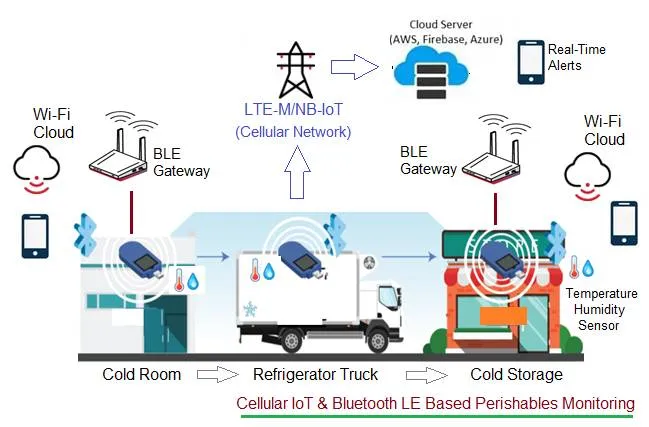 Figure-1 : Cellular IoT BLE Perishables Monitoring System Architecture
The Spoke: Bluetooth LE Nodes
The environmental data is collected at the edge by Bluetooth Low Energy (BLE) Nodes. These compact devices are deployed inside the cool rooms and refrigeration units.
- Sensor Capabilities: They utilize internal or external sensors to continuously measure localized temperature, humidity and pressure.
- Wireless Technology: Each node is powered by BLE SoC. This allows the nodes to transmit their telemetry data wirelessly to a central hub via Bluetooth LE. The ultra-low power consumption of the BLE technology ensures that these battery operated nodes can run for extended periods without maintenance, even in harsh, cold environments.
The Hub: Cellular IoT + Bluetooth LE
The critical link in this architecture is “Hub”, which acts as a combined sensor and data concentrator.
- Dual-Connectivity: The hub integrates BLE SoC to receive the incoming Bluetooth LE broadcasts from the various nodes scattered throughout the facility.
- Cloud Backhaul: Once the hub aggregates this data, it relies on cellular IoT module to relay the information to the cloud. By utilizing Cellular IoT, the hub completely bypasses the need for local IT infrastructure or Wi-Fi. It connects directly to global cellular networks, ensuring a secure, highly reliable data pipeline directly to Cloud platforms (such as AWS, Firebase, Azure etc).
Example Hardware Implementation using Nordic Semiconductor SoCs
- Nordic Semiconductor supplied Bluetooth LE SoC with part number nRF52832. This can be incorporated on BLE nodes (i.e. “Spoke”)planned to be installed inside cool rooms and storage rooms where requirement is indoor only.
- Nordic Semiconductor offers cellular IoT nRF9160 module which houses LTE-M/NB-IoT modem and GNSS. The nRF9160 consists of Arm Cortex M33 processor, RF front end and power management system.
- Both nRF9160 cellular SoC and nRF52832 BLE SoC are incorporated on modules (i.e. “Hub”) planned to be used both outdoors and limited indoors.
How Cellular IoT+BLE Architecture Works
- Continuous Sampling: The Edge Nodes continuously monitor the micro-climates within specific refrigeration units using temperature/humidity sensors.
- Local Transmission: Data is beamed via Bluetooth LE to the nearby “Hub”.
- Remote Backhaul: The “Hub” packages the data and transmits it over LTE-M or NB-IoT networks to the cloud backend (AWS, Azure, nRFCloud etc).
- Actionable Insights: Facility managers and pharmacists access this data remotely via a dedicated mobile app or web dashboard.
- If the temperature or humidity strays outside of predefined safety thresholds, the system can instantly alert stakeholders, allowing them to take corrective action before the inventory is spoiled.
Key Benefits of Integrated Cellular IoT & BLE Architecture
-
Because the backhaul relies on Cellular IoT (LTE-M/NB-IoT), the system is effectively plug and play. It does not require complex integration with hospital or warehouse Wi-Fi networks, which are often heavily firewalled or have poor penetration in insulated cool rooms.
-
By using cost effective, low power Bluetooth LE for the individual sensor nodes, facilities can deploy dozens of monitoring points economically, funneling all data through a single Cellular IoT hub.
-
Automated, continuous data logging ensures an unbroken audit trail for pharmaceutical regulators, proving that sensitive medical products were stored correctly 24/7.
-
Real-time cellular cloud connectivity transforms cold chain management from a reactive process (throwing away spoiled goods) into a proactive one (fixing a failing refrigeration unit before the temperature drops too low).
Summary
The combination of Bluetooth LE and Cellular IoT represents the gold standard for monitoring high value, highly sensitive perishables. As explained, this hybrid wireless architecture provides the perfect balance of localized, low power sensor networks and robust, global cloud connectivity; ultimately ensuring that life saving pharmaceuticals reach patients safely and effectively.
Continue Learning Cellular IoT (NB-IoT, LTE-M), Bluetooth LE & Wi-Fi
- Cellular IoT Overview
- LTE NB-IoT Basics Tutorial
- LTE NB-IoT Network Architecture
- LTE-M basics tutorial
- LTE-M Architecture
- LTE NB-IoT Vs LTE-M
- IoT Wireless Technologies and Standards
- Top 10 Applications of IoT
- Bluetooth Basics Tutorial
- Bluetooth Low Energy (BLE) Basics Tutorial
- WLAN Basics Tutorial