
BLE Smart Health Band: Architecture, Working, Hardware Design
Advertisement
A BLE Smart Health Band combines a low power microcontroller, Bluetooth Low Energy radio, sensors, display, battery and power-management circuitry and embedded firmware to deliver connected wearable functions while managing a limited energy budget. This article explains how a BLE Smart Health Band works and covers its architecture, major hardware components, communication flow, firmware design and key engineering considerations. The band or watch design is similar except the mechanical layout & design.
The watch or band typically communicates with a smartphone or other central device using BLE advertising, connection procedures and GATT services and characteristics for structured data exchange. Designing a Smart Health Band therefore requires coordination between BLE architecture, hardware selection, RF design, sensor integration, power optimization, GATT services, firmware architecture, security and mobile device connectivity.
Working of BLE based Smart Health Band Architecture
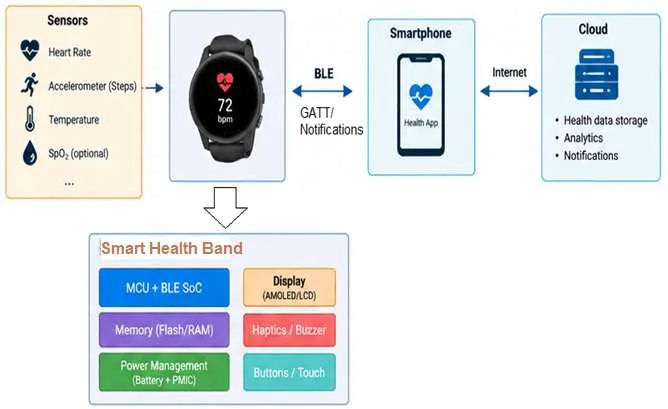
The figure depicts generic architecture of BLE Smart Health Band use case. Typically Smart Health Band houses sensors, BLE SoC, display, User Interface (keys or buttons) and battery. Following steps describe working of this BLE compatible Smart Health Band system.
- Sensors mounted on the Smart Health Band collect health/fitness data and MCU processes it.
- Data is sent via BLE to smartphone using standard profiles (e.g. heart rate, health thermometer, battery service etc.).
- The smartphone app installed shows real time data and also syncs with the cloud for long term tracking and insights.
Typical Specifications of Smart Health Band or Smartwatch (Example : MI Smart Band 5)
| No | Tech Spec | MI Smart Band 5 |
|---|---|---|
| 1 | PPG Heart rate sensor | Yes |
| 2 | SpO2 sensor | No |
| 3 | Gyroscope | Yes (3-Axis) |
| 4 | 3-Axis or 6-Axis accelerometer | Yes (3-Axis) |
| 5 | Rotor Vibration motor | No |
| 6 | Display | AMOLED |
| 7 | Screen Size | 2.79cm |
| 8 | Touch screen | Yes |
| 9 | Resolution | 126 x 294 |
| 10 | Button | Yes |
| 11 | Bluetooth | BLE 5.0 |
| 12 | Battery | Lipo 125mAh |
| 13 | Charging time | 2 Hour |
| 14 | Stndby time | 15 Days |
| 15 | Body Material | Polycarbonate |
| 16 | Strap Material | Thermoplastic polyurethane |
| 19 | System requirement | Android 5.0 or above |
| 20 | System requirement | iOS 10.0 or above |
| 21 | Sport mode | 11 |
| 22 | Step counting | Yes |
| 23 | Sleep checking | Yes |
| 24 | Water Resistant | 5 ATM |
| 25 | All day heart rate | Yes |
| 26 | Sedentary reminder | Yes |
| 27 | Clock | Yes |
| 28 | Timer | Yes |
| 29 | Countdown | Yes |
| 30 | Notification | Yes |
| 31 | Find phone | Yes |
| 32 | Weather | Yes |
| 33 | Charging status | Yes |
| 34 | OTA upgrade | Yes |
| 35 | Remote music control | Yes |
| 36 | Weight | 12gram |
| 37 | Charging type | Magnetic |
BLE Smart Health Band or Smartwatch Hardware Design
The common components which can be used for such smart health band design are as follows.
- BLE SoC and MCU Combined (nRF54L15 or nRF54L10 or nRF52840)
- MAXM86161A integrates photodiode, LED drivers, optical AFE, 19-bit ADC and ambient light cancellation.
- TI AFE4950 has integrated wearable biosensing AFE supporting synchronized PPG + single lead ECG acquisition.
- Low Power Accelerometer (Bosch BMA530/BMA580 family, ST LIS2DUXS or KX122)
- Use ADI MAX30208 sensor for skin temperature measurement.
- AMOLED display (0.95 inch size)
- 1000 mAh LiPo Battery
Note : ADI’s MAXREFDES103 reference design specifically combines MAX32664 + MAX86141 for wrist based HR, SpO₂, HRV, respiration and sleep related algorithms. Refer features of MAXREFDES103 reference design >>.
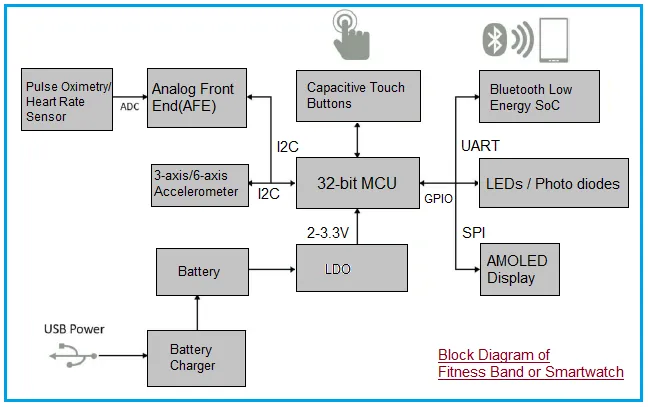
The figure depicts block diagram of fitness band or smartwatch. The fitness band can also be developed using Microchip components such as BLE SoC (BM70/71), 32-bit MCU (SAM D21/L21/E51), Battery charger (MCP73830/L), capacitive touch buttons, LDO (Low Dropout) voltage regulator and so on.
Summary
The choice of hardware components and design of smart health band or smartwatch depends on desired features planned to be incoporated on it. Commonly available smart band manufacturers are Realme, Redmi, Noise, Huawei, Honor, MI, Samsung etc.
Continue Learning More BLE Use Cases
- BLE Asset Tracking: Tags, Beacons, Gateways & Architecture
- BLE Digital Car Keys: Architecture, Working, Benefits & Limitations
- BLE Electronic Shelf Labels: Architecture, Working & Design
- BLE in Wearables: Architecture, Working, Benefits & Limitations
Continue Learning Bluetooth Basic Concepts
- What are new features in Bluetooth 6.3 Version
- Bluetooth GATT Vs. ATT Vs. GAP : Key Comparison
- Bluetooth Service Vs. Characteristic Vs. Descriptor
- Bluetooth Central Vs. Peripheral : Key Differences
- Bluetooth pairing Vs. Bonding Phase
- Bluetooth Notifications Vs. Indications
- Bluetooth Channel Sounding Vs. RSSI
- Bluetooth Error Codes Guide : Meanings, Causes & Fixes
Continue Learning Bluetooth Technology
- Bluetooth Basics Tutorial
- Bluetooth Low Energy (BLE) Basics Tutorial
- Bluetooth Protocol Stack & Device State Diagram
- Bluetooth Physical Layer Modules
- Bluetooth MAC Layer Overview
- Bluetooth Channel Frequency List
- Bluetooth Network Security
- Bluetooth Low Energy (BLE) Connection Establishment Procedure
- Bluetooth Profiles: HFP, HSP, A2DP, AVRCP, PBAP & MAP
- Bluetooth Mesh Node Types & Protocol Stack Layer Functions
Compare Bluetooth With Other Technologies
- Bluetooth V5.0 Vs. V5.1 Vs. V5.2 Vs. V5.3
- Bluetooth Vs BLE : Key Differences
- Bluetooth Vs UWB Technology : Key Differences
- Bluetooth Vs Wi-Fi Vs UWB
Explore Deep Insight Bluetooth Technology
- Bluetooth AFH Explained: Adaptive Frequency Hopping & FAQs
- Bluetooth Error Recovery : ARQ, ACK, NAK
- Bluetooth Bit Stream Processing: HEC, CRC, FEC & More
- Bluetooth Routing: How Devices Know a Packet is for Them
- Bluetooth Flow Control: Understanding GO & STOP Bits
- Bluetooth Power Management: Sniff, Hold & Active Modes
- Bluetooth Packets Decoded: Structure, Types & Routing
- Decoding Bluetooth Packet Types: Control, ACL, SCO & eSCO