
Bluetooth Beacon : iBeacon Vs. Eddystone Standards Explained
Advertisement
While Global Navigation Satellite Systems (GNSS) like GPS have revolutionized outdoor navigation, they hit a literal brick wall when it comes to the indoors. GNSS signals simply cannot penetrate concrete, steel and dense urban infrastructure. To bridge this gap, the tech industry turned to a technology already residing in billions of pockets worldwide i.e. Bluetooth.
Powered by Bluetooth Low Energy (Bluetooth LE), beacons have become the foundational hardware for indoor positioning, proximity marketing and asset tracking. This article covers what exactly is a beacon, how does it work and what are the industry standards driving this technology.
What is a Bluetooth Beacon?
At its core, a beacon is a small, battery powered wireless transmitter. Think of it as a digital lighthouse. Just as a lighthouse emits a continuous beam of light to tell passing ships exactly where they are, a beacon repeatedly broadcasts a continuous radio signal (i.e. advertising packet) to nearby Bluetooth enabled devices, such as smartphones, tablets or IoT gateways.
It is important to note that traditional beacons are one way transmitters. They do not connect to your phone or steal your data; they merely broadcast their unique identifier. When a smart device comes within range, a dedicated app or operating system detects this identifier and triggers a specific action such as displaying an in-store coupon, opening an indoor map or logging the location of a moving warehouse pallet.
The Evolution of Beacon Hardware
Modern beacons have evolved far beyond simple broadcasting. According to recent industry developments from Nordic Semiconductor, next-generation beacons are incredibly versatile.
For example, the Minew MBM04 location relay beacon, powered by Nordic’s ultra-low power nRF54L15 System on Chip (SoC), supports configurable working modes. Instead of just acting as a “dumb” broadcaster, modern beacons can function as following.
- Beacons: Broadcasting their identity for detection.
- Anchors: Providing a stable, fixed reference point for complex indoor positioning algorithms.
- Relays: Scanning for nearby Bluetooth LE tags and forwarding that data to a network gateway, expanding coverage without requiring expensive hardwired infrastructure.
With advanced multi-anchor positioning algorithms, these modern systems can achieve 1 to 3 meters of accuracy, making them ideal for dense, multi-floor environments.
Understanding Beacon Standards
While the hardware utilizes standard Bluetooth LE, the language the beacon speaks; how the broadcast packet is structured; depends on its protocol standard. The two undisputed standards are Apple’s iBeacon and Google’s Eddystone.
1. iBeacon (Apple)
Introduced by Apple in 2013, iBeacon was the first major beacon protocol and remains the most widely adopted standard for iOS and enterprise applications. It is a proprietary, closed source standard, though it is fully compatible with Android devices via third party apps.
How iBeacon Works:
iBeacon transmits a very simple, lightweight payload consisting of three main identifiers:
- UUID (Universally Unique Identifier): A 16-byte string that identifies the brand or overarching organization (e.g. specific retail chain).
- Major Value: A 2-byte string that identifies a specific sub-group or location (e.g. a specific store branch in New York).
- Minor Value: A 2-byte string that identifies the exact micro-location (e.g. the shoe aisle in the New York store).
Best Use Cases: iBeacon is perfect for straightforward proximity sensing. Apple devices divide iBeacon proximity into three ranges viz. Immediate (centimeters away), Near (a couple of meters) and Far (up to 30+ meters). It is ideal for triggering push notifications in retail, museum audio guides and basic check-in systems.
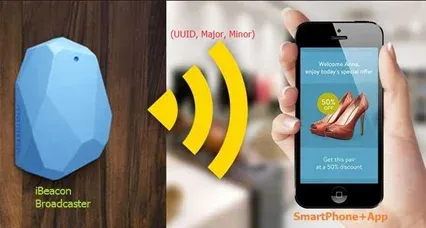 Figure-1 : iBeacon Installation and Working
2. Eddystone (Google)
Launched by Google in 2015, Eddystone was developed as an open source, cross platform alternative to iBeacon. While Google has since deprecated its “Nearby Notifications” feature on Android smartphones (which previously allowed Eddystone to push alerts without an app), the protocol remains heavily utilized in industrial IoT and enterprise asset tracking.
How Eddystone Works:
Unlike iBeacon’s single payload structure, Eddystone is highly versatile and supports four different “frame types” that can be broadcast simultaneously.
- Eddystone UID: Similar to iBeacon, it broadcasts a unique namespace and instance ID for proximity triggering.
- Eddystone URL: Broadcasts a compressed web address. This was the backbone of the “Physical Web,” allowing users to interact with physical objects by opening a webpage without needing to download a dedicated app.
- Eddystone TLM (Telemetry): This is a game changer for fleet management. It broadcasts the beacon’s own health data, such as battery voltage, device temperature and the number of packets sent. This allows IT managers to proactively replace batteries before a beacon dies.
- Eddystone EID (Ephemeral ID): A secure frame that broadcasts a rotating, encrypted identifier to prevent “spoofing” and unauthorized tracking of the beacon.
Best Use Cases: Eddystone shines in industrial IoT, fleet management and secure asset tracking. Its Telemetry (TLM) frame is invaluable for maintaining massive networks of beacons in warehouses or smart buildings, saving maintenance teams from manually checking thousands of batteries.
Difference between iBeacon vs. Eddystone
| Feature | iBeacon (Apple) | Eddystone (Google) |
|---|---|---|
| Type | Proprietary / Closed Source | Open Source |
| Compatibility | Native to iOS; works on Android via apps | Cross-platform (Android & iOS) |
| Payload Complexity | Simple (UUID, Major, Minor) | Versatile (UID, URL, Telemetry, Encrypted ID) |
| Best For | Retail, Customer Engagement, iOS ecosystems | Industrial IoT, Asset Tracking, Fleet Management |
| Security | Basic | Advanced (via Ephemeral ID) |
Many modern beacon manufacturers design their hardware to be multi-protocol. Devices utilizing modern chipsets can interleave their broadcasts, transmitting iBeacon packets for customer facing iOS apps and Eddystone TLM packets for backend maintenance systems simultaneously.
The Future of Beacons : Bluetooth Channel Sounding
The beacon landscape is on the verge of another major evolution. The concept of Bluetooth Channel Sounding has been added in latest release of Bluetooth Core Specification 6.0.
Historically, beacons estimated distance based on signal strength (RSSI), which can fluctuate based on physical obstacles or human bodies. Channel Sounding introduces phase based ranging, which calculates the actual time of flight of the radio waves. This will give next generation beacons true distance awareness with highly secure, sub-meter accuracy.
As indoor positioning demands evolve from simple proximity alerts to mission critical asset tracking and automated industrial safety zones, the combination of advanced standards and ultra-low power Bluetooth LE hardware ensures that beacons will remain the guiding light of the IoT ecosystem.
Continue Learning Bluetooth Technology
- Bluetooth Basics Tutorial
- Bluetooth Low Energy (BLE) Basics Tutorial
- Bluetooth Protocol Stack & Device State Diagram
- Bluetooth Physical Layer Modules
- Bluetooth MAC Layer Overview
- Bluetooth L2CAP and HCI : Key Differences