
Cellular IoT Water Pipe Leak Detection: Architecture & Benefits
Advertisement
Water damage is one of the most persistent and costly issues facing commercial, industrial and institutional properties. Early detection is critical to preventing catastrophic property damage and conserving precious water resources. To achieve this, building managers require smart, easily deployable monitoring systems. This article explains Cellular IoT based architecture to deliver a highly responsive, non-invasive pipe leak detection system.
The Challenge: Overcoming the Limitations of Traditional LPWANs
Monitoring water usage and detecting leaks across large, complex building infrastructures requires robust wireless connectivity. There are tracking solutions available using LoRaWAN; a popular Low Power Wide Area Network (LPWAN) technology.
However, deploying LoRaWAN in commercial real estate often introduces operational friction. It typically requires the installation and maintenance of proprietary gateways to relay data from the sensors to the cloud, adding to deployment complexity. Moreover, this approach will have more response times to alert managers monitoring the water pipelines. Hence when a pipe bursts or a slow leak begins, it is difficult to intimate facility managers immediately before significant damage occurs.
The Solution: Cellular IoT Architecture and Sensor Hardware
To eliminate deployment barriers and enhance real time responsiveness, direct to cloud Cellular IoT architecture has been developed. The figure depicts smart valve, water meter and pressure sensor directly communicating with cellular base station. The cellular infrastructure relays information to the cloud and consecutively it will be pushed to the mobile phone app or web portal.
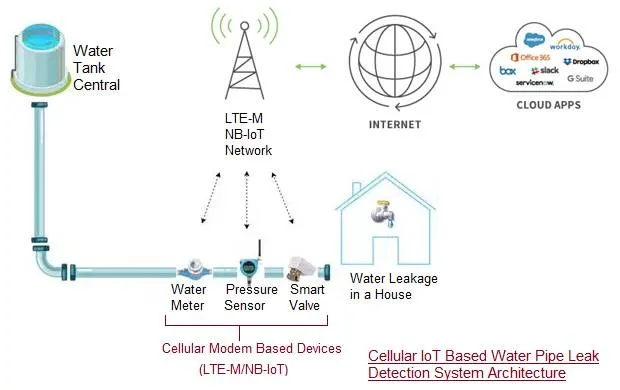 Figure-1 : Cellular IoT Based Water Pipe Leak Detection Architecture
There are numerous devices available to monitor Water leakage.
- One such device is ultrasonic clamp-on sensor designed to be attached directly to the exterior of pipes anywhere within a building’s infrastructure, including risers and branch lines. By utilizing ultrasonic technology, it non-invasively monitors flow and helps localize the exact origin of leaks or water usage anomalies within specific zones of a property.
- The other device is non-invasive, battery-powered sensor device which connects seamlessly with a building’s existing utility water meter. It continuously measures the building’s total water flow, utilizing edge-processing algorithms to detect abnormal usage patterns that could indicate hidden leak or defect in the broader plumbing network.
Example Hardware Implementations of Sensors using Nordic SoC
Nordic semiconductor’s cellular SoCs such as nRF9160 or nRF9151 can be used to provide cellular connectivity to sensors. Instead of relying on local gateways, each sensor connects directly to existing commercial LTE-M or NB-IoT cellular networks. The nRF9151 utilizes low power LTE technology to relay flow data and leak alerts directly to the cloud platform for real time analysis and user notification.
Key Benefits of Cellular IoT Approach for water leakage monitoring
-
The most significant operational advantage of Cellular IoT over LoRaWAN is “out of the box” connectivity. Because the sensors connect directly to global cellular networks, building managers do not need to install local gateways, configure routers or integrate with heavily firewalled corporate Wi-Fi networks. The sensors simply clamp on, power up and connect.
-
Water damage scales exponentially with time. By utilizing LTE-M/NB-IoT networks, the cellular compliant sensors benefit from highly reliable, low latency data transmission. If an ultrasonic sensor detects a sudden surge in water flow indicative of a burst pipe, the alert is transmitted to facility managers immediately, vastly improving emergency response times.
-
Moreover use of Nordic SoC such as nRF9151 offers features such as advanced processing capabilities and robust security protocols. This allows the devices to perform local, on-device analysis of water flow patterns (edge computing) to distinguish between normal usage and a genuine defect, transmitting data only when necessary. Furthermore, enterprise-grade security ensures that building utility data remains protected from interception.
-
For battery powered, non-invasive sensors, form factor and energy efficiency are paramount. The high integration of the nRF9151 allows designed sensors to maintain an ultra-compact device profile while keeping manufacturing costs down. Crucially, the ultra-low power consumption of Cellular IoT ensures these devices can operate unattended on battery power for years, minimizing maintenance overhead.
Summary
Transitioning from gateway dependent LPWANs to Cellular IoT has revolutionized how commercial and industrial properties monitor water usage. By combining non-invasive, ultrasonic hardware with the deployment simplicity and rapid response times of the Nordic nRF9151 cellular module, such water monitoring Sensors has delivered a scalable, cost effective solution. This architecture not only protects valuable real estate from devastating water damage but also plays a vital role in modern resource conservation.
Continue Learning Cellular IoT (NB-IoT, LTE-M), Bluetooth LE & Wi-Fi
- Cellular IoT Overview
- LTE NB-IoT Basics Tutorial
- LTE NB-IoT Network Architecture
- LTE-M basics tutorial
- LTE-M Architecture
- LTE NB-IoT Vs LTE-M
- IoT Wireless Technologies and Standards
- Top 10 Applications of IoT
- Bluetooth Basics Tutorial
- Bluetooth Low Energy (BLE) Basics Tutorial
- WLAN Basics Tutorial