
Cellular IoT & Wi-Fi Asset Tracking : Hybrid Architecture & Benefits
Advertisement
The logistics and supply chain sectors are increasingly demanding continuous, end to end visibility of their mobile and distributed assets. While traditional Global Navigation Satellite Systems (GNSS) are highly effective outdoors, they consume significant power and fail to penetrate indoor environments or dense urban areas. To address this, developers are pivoting to hybrid Cellular IoT architectures. This article explores the architecture, hardware design and key benefits of utilizing cellular IoT combined with Wi-Fi positioning for seamless indoor and outdoor asset tracking.
The Challenge: Bridging the Indoor-Outdoor Gap
Tracking an asset’s journey typically involves traversing both outdoor and indoor environments, such as warehouses, cool rooms and transit hubs. Relying solely on cellular or GPS technologies presents following two major hurdles.
- Signal Penetration: GNSS signals degrade rapidly indoors, leaving blind spots in critical operational areas.
- Power Consumption: The radio is the most power hungry component of any IoT device. Constantly searching for a satellite fix in a weak signal indoor environment drains batteries exponentially, making multi-year deployment impossible.
The Solution: Hybrid Cellular IoT Architecture
To solve this, modern asset trackers have adopted a hybrid positioning architecture that leverages Cellular IoT (LTE-M/NB-IoT) as the primary backhaul, supported by Wi-Fi scanning for precise indoor locationing.
The architecture is designed to shift heavy computation from the edge device to the cloud, significantly optimizing battery life.
-
Indoor Positioning (Wi-Fi Scanning): When an asset moves indoors, the device disables GNSS to save power. Instead, it utilizes SSID based Wi-Fi scanning. The device captures nearby Wi-Fi MAC (media access control) addresses but does not connect to the networks.
-
Cellular Data Pipeline: The captured MAC addresses, along with any sensor data, are packaged and transmitted via the Cellular IoT network (such as LTE-M or NB-IoT) to a standardized backend such as AWS, Firebase, Azure and Nordic nRF Cloud.
-
Cloud-Side Resolution: The cloud infrastructure processes the Wi-Fi scan data against global databases to resolve the asset’s position, achieving an indoor accuracy of 2 to 50 meters. By offloading this complex geolocation processing from the device to the cloud, the architecture vastly reduces on-device power consumption.
-
Cellular Fallback: In edge cases where neither GNSS nor Wi-Fi is available, cell-based locationing (using the cellular network’s own masts) is used to estimate the position.
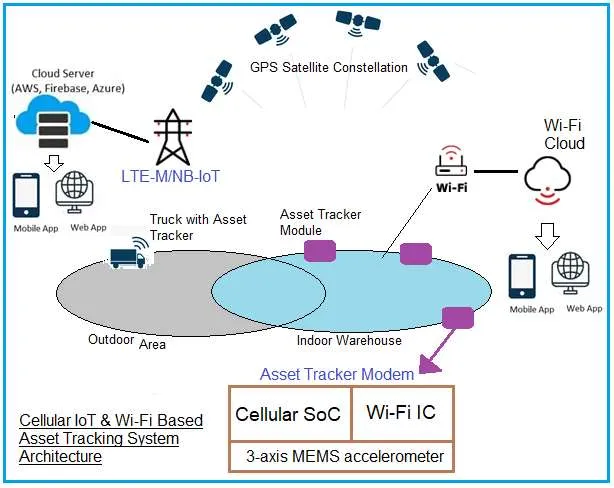 Figure-1 : Cellular IoT Wi-Fi Asset Tracking Architecture
The figure depicts architecture of this hybrid cellular IoT/Wi-Fi based asset tracking system. As shown, the assets are being tracked by GPS Satellites and Cellular Base Stations (LTE-M, NB-IoT) and they are managed by Wi-Fi in indoors. The assets can be monitored using mobile and web apps by connecting them with asset trackers through cloud.
Example Hardware Design of Cellular IoT Asset Tracker Using Nordic SoCs
Achieving a multi-year operational lifetime requires highly integrated, power efficient hardware. The hardware design of a state of the art Cellular IoT tracker involves several key components:
-
Cellular SoC: Traditional designs use a separate host microcontroller (MCU), cellular modem and external memory; a setup that introduces latency and drains power through constant inter-component communication. Modern designs utilize highly integrated modules like the Nordic nRF9151, which packs multimode LTE-M/NB-IoT modem, Arm Cortex-M33 application processor, 1 MB Flash and 256 KB RAM into a single compact footprint.
-
Wi-Fi IC: For the indoor tracking element, a dedicated, low-power Wi-Fi IC is integrated alongside the cellular module. It is selectively powered on solely to sniff local Wi-Fi networks for positioning. Nordic nRF7000 Wi-Fi 6 IC can fulfill this hardware requirement.
-
Condition Monitoring Sensors: Hardware designs frequently incorporate 3-axis MEMS accelerometers. Supervised directly by the cellular module’s integrated application processor, these sensors detect motion, tilt, tampering or unauthorized opening.
-
Data Transmission Design: To preserve the battery, hardware is configured to utilize UDP (User Datagram Protocol) over TCP. UDP sends packets without the power hungry multi-step connection “handshake,” making it highly efficient for the small data payloads typical of asset trackers.
-
Reference : For more information, Visit : Nordicsemi.com website.
Key Benefits of Cellular IoT Asset Tracking
-
By integrating power saving features natively supported by LTE-M/NB-IoT networks, such as Power Saving Mode (PSM) and Extended Discontinuous Reception (eDRX), devices can enter deep sleep states and only wake up during defined “listening windows.” Combined with cloud side location processing, these trackers can operate for years on single battery, eliminating the logistical nightmare of constant battery replacements.
-
The hybrid transition between GNSS (outdoors) and Wi-Fi scanning (indoors) ensures that fleet managers never lose sight of their assets. Whether an asset is on a highway or buried deep inside a concrete distribution center, the system dynamically selects the most efficient technology to report its location.
-
Because modern cellular modules feature powerful onboard processors, they function as smart edge computers. Instead of transmitting a constant stream of raw data, the tracker can run algorithms locally to monitor conditions. For example, it will only wake the cellular radio and transmit an alert if the MEMS accelerometer detects a severe impact (such as dropping) or if temperature parameters for perishable goods are breached.
-
Moving away from multi-chip hardware setups to single package cellular modules significantly reduces the physical size of the tracker. This compact form factor allows the devices to be discreetly attached to a wider variety of assets, while the reduced component count lowers manufacturing complexity and costs.
Summary
The integration of Cellular IoT with Wi-Fi companion technologies represents a major leap forward for asset tracking. By marrying intelligent hardware design with a cloud offloaded architecture, developers are overcoming the historical trade-offs between tracking accuracy and battery life. As supply chains become increasingly digitized, these ultra-low power, globally connected, and context-aware devices will form the backbone of modern logistics and indoor asset management.
Continue Learning Cellular IoT (NB-IoT, LTE-M), Bluetooth LE & Wi-Fi
- Cellular IoT Overview
- LTE NB-IoT Basics Tutorial
- LTE NB-IoT Network Architecture
- LTE-M basics tutorial
- LTE-M Architecture
- LTE NB-IoT Vs LTE-M
- IoT Wireless Technologies and Standards
- Top 10 Applications of IoT
- Bluetooth Basics Tutorial
- Bluetooth Low Energy (BLE) Basics Tutorial
- WLAN Basics Tutorial