
LTE PCH Physical Layer Processing Explained
Advertisement
This page describes the basic function of the LTE PCH (Paging Channel) and details the physical layer processing for the transmitter part. You can also find a reference link to the LTE physical layer.
The LTE PCH channel carries RRC paging messages using RLC (Radio Link Control) in transparent mode and the PCCH (Paging Control Channel) logical channel. The PCH Transport block will have a variable size, which depends on the content of the paging message.
The LTE PCH physical layer processing for the transport block is illustrated in the figure below.
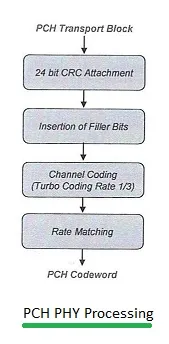
The following steps are involved in the physical layer processing of PCH data:
-
CRC (Cyclic Redundancy Check): CRC helps in error detection at the receiver. This allows the receiver to determine if the received data has been corrupted during transmission.
-
Insertion of Filler Bits: Insertion of filler bits ensures that the block of data has a size of at least 40 bits. This is a minimum size requirement for subsequent processing steps.
-
Channel Coding: Channel coding helps in forward error correction (FEC) at the receiver. FEC adds redundancy to the data, allowing the receiver to correct some errors without retransmission.
-
Rate Matching: The rate matching module interleaves and adjusts the quantity of data to match the capacity offered by the PDSCH (Physical Downlink Shared Channel). This ensures efficient use of the available radio resources.
-
Modulation and Mapping: After rate matching, the PCH codeword is QPSK (Quadrature Phase Shift Keying) modulated and later mapped to allocated PDSCH resource elements. This prepares the data for transmission over the air interface.
The paging message is transferred during a 1ms subframe (i.e., during the paging occasion of the DRX (Discontinuous Reception) cycle).
Continue Learning 4G LTE
- 4G LTE Basics Tutorial
- 4G LTE Architecture: Network Elements and Interfaces
- LTE Frame Structure
- LTE Channel Types: Logical, Transport and Physical Channels
- LTE Protocol Stack: User Plane vs. Control Plane
- 4G LTE Physical Layer & its modules
- LTE Frequency Bands: FDD, TDD and E-UTRA Bands
- LTE Carrier Aggregation & its benefits
- 4G LTE Network Security
- LTE Cell Search Procedure
- LTE UE Uplink Network Entry : Random Access Procedure
- LTE Paging Procedure Mechanism and Call Flow
Explore More 4G LTE Frame Essentials
- LTE Terminologies
- LTE TDD and FDD Frame Types
- LTE PSS vs SSS : Key Differences
- LTE Reference Signals: RS, DMRS, and SRS
Explore More LTE Channels
- LTE PBCH Physical Broadcast Channel
- LTE PCFICH Channel : Physical Control Format Indicator Channel
- LTE PDCCH : Physical Downlink Control Channel
- LTE PDSCH Channel : Physical Downlink Shared Channel
- LTE PHICH: Physical Hybrid ARQ Indicator Channel
- LTE PMCH : Physical Multicast Channel
- LTE PRACH Channel: Physical Random Access Channel
- LTE PUCCH: Physical Uplink Control Channel
- LTE PUSCH: Physical Uplink Shared Channel