
LTE PUSCH: Physical Uplink Shared Channel Explained
Advertisement
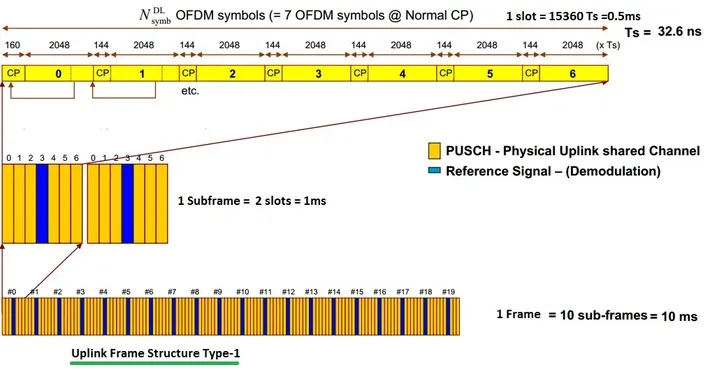
This page describes the LTE PUSCH channel, or Physical Uplink Shared Channel, within the context of the LTE system. This channel is used to carry RRC signaling messages, UCI (Uplink Control Information), and application data.
Uplink RRC messages are carried using PUSCH. SRBs (Signaling Radio Bearers) utilize PUSCH, and each connection will have its unique SRB.
- LTE PUSCH channel contains user information data.
- The PUSCH carries both user data as well as control signal data. Control information carried can include MIMO-related parameters and transport format indicators.
- The control data information is multiplexed with the user information before the DFT spreading module in the uplink SC-FDMA physical layer.
- PUSCH supports QPSK, 16QAM, and 64QAM (optional). The LTE eNodeB selects a suitable modulation scheme based on an adaptation algorithm.
UCI is transmitted using PUSCH instead of PUCCH when there is RRC and application data to be transferred at the same time instant.
Modulation type is conveyed to the UE using PDCCH DCI format-0. This CI (Control Information) also signals RB allocation and TB (Transport Block) size.
Refer to the LTE DCI page for contents of various LTE DCI formats.
LTE PUSCH channel uses QPSK when TTI (Transmission Time Interval) bundling is enabled.
If the eNodeB directs the UE to use 64QAM, but the UE does not support it, then 16QAM modulation type is selected.
Explore More LTE Channels
- LTE PBCH Physical Broadcast Channel
- LTE PCFICH Channel : Physical Control Format Indicator Channel
- LTE PDCCH : Physical Downlink Control Channel
- LTE PDSCH Channel : Physical Downlink Shared Channel
- LTE PHICH: Physical Hybrid ARQ Indicator Channel
- LTE PMCH : Physical Multicast Channel
- LTE PRACH Channel: Physical Random Access Channel
- LTE PUCCH: Physical Uplink Control Channel
- LTE PSS vs SSS: Primary and Secondary Synchronization Signals
- LTE Reference Signals: RS, DMRS, and SRS
Continue Learning 4G LTE
- 4G LTE Basics Tutorial
- 4G LTE Architecture: Network Elements and Interfaces
- LTE Frame Structure
- LTE Channel Types: Logical, Transport and Physical Channels
- LTE Protocol Stack: User Plane vs. Control Plane
- 4G LTE Physical Layer & its modules
- LTE Frequency Bands: FDD, TDD and E-UTRA Bands
- LTE Carrier Aggregation & its benefits
- 4G LTE Network Security
- LTE Cell Search Procedure
- LTE UE Uplink Network Entry : Random Access Procedure
- LTE Paging Procedure Mechanism and Call Flow