
LTE PHICH: Physical Hybrid ARQ Indicator Channel Explained
Advertisement
This page describes the LTE PHICH (Physical Hybrid ARQ Indicator Channel) with respect to the LTE system. The PHICH is used to carry positive or negative acknowledgements for uplink data transferred on the PUSCH. These acknowledgements are referred to as ACK/NACK.
Each connection can carry a maximum of 1 TB (Transport Block) per subframe on PUSCH. Therefore, a maximum of 1 PHICH ACK per subframe per connection is needed.
A PHICH ACK is identified by two parameters:
- PHICH Group
- PHICH Orthogonal sequence index within the PHICH group
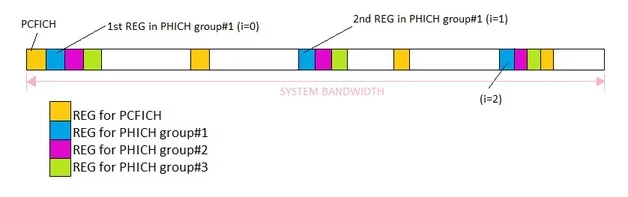 Image alt: LTE PHICH
As shown in the figure, three REGs (Resource Element Groups) that support a PHICH group are evenly distributed across the LTE system bandwidth. This provides frequency diversity.
As previously stated, the PCFICH always appears and occupies the first symbol of each subframe. The PCFICH occupies 4 REGs irrespective of the channel bandwidth.
The number of PHICH groups is a function of the downlink channel bandwidth and the PHICH group scaling factor. Both the downlink channel bandwidth and PHICH group scaling factor are transmitted within the MIB (Master Information Block) and carried by the LTE PBCH channel.
The table below details the number of PHICH groups for various scaling factors, Cyclic Prefixes (CPs), and channel bandwidths.
| 1.4MHz | 3MHz | 5MHz | 10MHz | 15MHz | 20MHz | |
|---|---|---|---|---|---|---|
| PHICH Group Scaling Factor | ||||||
| Normal CP 1/6 | 1 | 1 | 1 | 2 | 2 | 3 |
| 1/2 | 1 | 1 | 2 | 4 | 5 | 7 |
| 1 | 1 | 2 | 4 | 7 | 10 | 13 |
| 2 | 2 | 4 | 7 | 13 | 19 | 25 |
| PHICH group scaling factor | ||||||
| Extended CP 1/6 | 2 | 2 | 2 | 4 | 4 | 6 |
| 1/2 | 2 | 2 | 4 | 8 | 10 | 14 |
| 1 | 2 | 4 | 8 | 14 | 20 | 26 |
| 2 | 4 | 8 | 14 | 26 | 38 | 50 |
The number of PHICH groups doubles when using an extended CP because the number of orthogonal sequences for each group is halved.
- Normal CP has 8 orthogonal sequences per PHICH group
- Extended CP has 4 orthogonal sequences per PHICH group
A UE (User Equipment) selects its PHICH group and orthogonal sequence index as per the following equations:
Where:
- = Lowest physical RB (Resource Block) index allocated to slot-1 of PUSCH
- = Demodulation RS (Reference Signal) cyclic shift signaled within LTE DCI-0
- = No. of PHICH groups
- = No. of orthogonal sequences per PHICH group (Normal CP: 8 and Extended CP:4)
Each PHICH ACK is modulated using BPSK (Binary Phase Shift Keying) modulation scheme and occupies:
- 12 REs (Resource Elements) when using normal CP
- 6 REs when using extended CP
PHICH ACKs belonging to the same group will occupy the same set of REs and are differentiated using orthogonal sequences.
In the extended CP case, PHICH groups are paired, and each pair of groups occupies 12 REs. The set of 12 REs allocated to each PHICH group is divided into three quadruplets.
The MIB on the PBCH (Physical Broadcast Channel) indicates whether PHICH uses normal CP or extended CP.
-
A normal CP means PHICH uses the first OFDMA symbol belonging to a subframe.
-
An extended CP means PHICH uses the first 3 OFDMA symbols belonging to a subframe.
-
REFERENCE: Document 3GPP TS 36.211
Explore More LTE Channels
- LTE PBCH Physical Broadcast Channel
- LTE PCFICH Channel : Physical Control Format Indicator Channel
- LTE PDCCH : Physical Downlink Control Channel
- LTE PDSCH Channel : Physical Downlink Shared Channel
- LTE PMCH : Physical Multicast Channel
- LTE PRACH Channel: Physical Random Access Channel
- LTE PUCCH: Physical Uplink Control Channel
- LTE PUSCH: Physical Uplink Shared Channel
- LTE PSS vs SSS: Primary and Secondary Synchronization Signals
- LTE Reference Signals: RS, DMRS, and SRS
Continue Learning 4G LTE
- 4G LTE Basics Tutorial
- 4G LTE Architecture: Network Elements and Interfaces
- LTE Frame Structure
- LTE Channel Types: Logical, Transport and Physical Channels
- LTE Protocol Stack: User Plane vs. Control Plane
- 4G LTE Physical Layer & its modules
- LTE Frequency Bands: FDD, TDD and E-UTRA Bands
- LTE Carrier Aggregation & its benefits
- 4G LTE Network Security
- LTE Cell Search Procedure
- LTE UE Uplink Network Entry : Random Access Procedure
- LTE Paging Procedure Mechanism and Call Flow