
LTE DL-SCH Basics and Physical Layer Processing
By RF Wireless Expert Team
Advertisement
This page describes the basic function of the LTE DL SCH (Downlink Shared Channel) and its physical layer processing. The LTE physical layer used for DL SCH processing is also described. DL-SCH is used to transmit SIBs (System Information Blocks), RRC signalling, and application data. Transport blocks of DL-SCH will have variable sizes.
DL-SCH can transmit either 1 or 2 TBs (Transport Blocks) of application data per subframe per connection. Two Transport blocks (TB) can be transmitted when the UE (User Equipment) is in a good coverage area and it is configured with either 2x2 MIMO or 4x4 MIMO.
The figure below depicts LTE DL SCH physical layer processing.
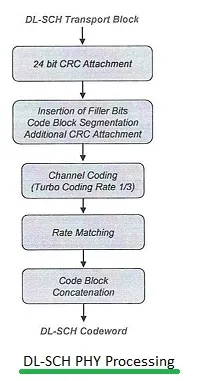
The following steps are involved in LTE DL SCH physical layer processing:
- CRC (Cyclic Redundancy Check): CRC allows error detection at the receiver.
- Segmentation: This module ensures that each block of data has a size of at least 40 bits and segments blocks of data larger than 6144 bits. It also adds an additional 24-bit CRC to any segmented blocks.
- Channel Coding: The channel coding module provides redundancy to protect the data across the air interface.
- Rate Matching: The rate matching module interleaves and adjusts the quantity of data to match the capacity offered by the PDSCH (Physical Downlink Shared Channel).
- Code Block Concatenation: Concatenation of individual code blocks occurs if segmentation was completed earlier. Code block concatenation is completed to generate a single codeword if segmentation is needed prior to the channel coding module.
- Modulation: DL-SCH codewords are modulated using QPSK, 16QAM, or 64QAM. QPSK is used for SI (System Information) transmission because QPSK is the most robust modulation scheme. 16QAM and 64QAM are used in good coverage conditions to benefit from higher data rates.
- Resource Mapping: Modulated codewords are mapped onto allocated PDSCH resource elements.
LTE Physical Layer
Continue Learning 4G LTE
- 4G LTE Basics Tutorial
- 4G LTE Architecture: Network Elements and Interfaces
- LTE Frame Structure
- LTE Channel Types: Logical, Transport and Physical Channels
- LTE Protocol Stack: User Plane vs. Control Plane
- 4G LTE Physical Layer & its modules
- LTE Frequency Bands: FDD, TDD and E-UTRA Bands
- LTE Carrier Aggregation & its benefits
- 4G LTE Network Security
- LTE Cell Search Procedure
- LTE UE Uplink Network Entry : Random Access Procedure
- LTE Paging Procedure Mechanism and Call Flow
Explore More 4G LTE Frame Essentials
- LTE Terminologies
- LTE TDD and FDD Frame Types
- LTE PSS vs SSS : Key Differences
- LTE Reference Signals: RS, DMRS, and SRS
Explore More LTE Channels
- LTE PBCH Physical Broadcast Channel
- LTE PCFICH Channel : Physical Control Format Indicator Channel
- LTE PDCCH : Physical Downlink Control Channel
- LTE PDSCH Channel : Physical Downlink Shared Channel
- LTE PHICH: Physical Hybrid ARQ Indicator Channel
- LTE PMCH : Physical Multicast Channel
- LTE PRACH Channel: Physical Random Access Channel
- LTE PUCCH: Physical Uplink Control Channel
- LTE PUSCH: Physical Uplink Shared Channel