
LTE PDSCH Channel: Physical Downlink Shared Channel Explained
Advertisement
This page describes the LTE PDSCH channel, also known as the Physical Downlink Shared Channel, within the context of the LTE system. The PDSCH channel is the primary channel for carrying data, dynamically and opportunistically allocated to users.
The PDSCH is also responsible for transmitting broadcast information that isn’t carried on the PBCH (Physical Broadcast Channel). This includes System Information Blocks (SIBs) and paging, as well as RRC (Radio Resource Control) signalling messages. Furthermore, application data is transferred via the PDSCH.
- Paging messages: These are broadcast using the PDSCH channel. An LTE UE (User Equipment) in RRC IDLE mode monitors the PDCCH (Physical Downlink Control Channel) for paging indications. Upon trigger, it decodes the paging message carried in the PDSCH RBs (Resource Blocks).
- Downlink RRC Signalling messages: The PDSCH carries these messages. Signalling Radio Bearers (SRB) utilize the PDSCH. Each connection typically has its own set of SRBs.
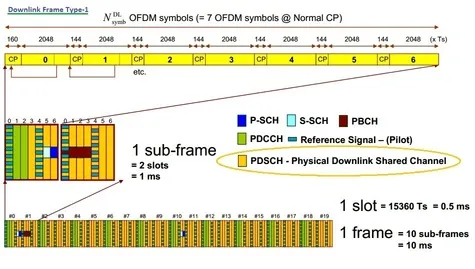
The LTE PDSCH channel employs QPSK, 16QAM, and 64QAM modulation schemes. The LTE eNodeB (evolved NodeB, or base station) selects the appropriate modulation type using an adaptation algorithm. This selection depends on the radio channel conditions and buffer capacity. QPSK, being the most robust scheme, is used for transmitting SIBs and Paging.
As the name suggests, PDSCH is a shared channel, meaning its RBs are shared among all active connections.
- LTE PDSCH channel Reference: 3GPP TS 36.211
Explore More LTE Channels
- LTE PBCH Physical Broadcast Channel
- LTE PCFICH Channel : Physical Control Format Indicator Channel
- LTE PDCCH : Physical Downlink Control Channel
- LTE PHICH: Physical Hybrid ARQ Indicator Channel
- LTE PMCH : Physical Multicast Channel
- LTE PRACH Channel: Physical Random Access Channel
- LTE PUCCH: Physical Uplink Control Channel
- LTE PUSCH: Physical Uplink Shared Channel
- LTE PSS vs SSS: Primary and Secondary Synchronization Signals
- LTE Reference Signals: RS, DMRS, and SRS
Continue Learning 4G LTE
- 4G LTE Basics Tutorial
- 4G LTE Architecture: Network Elements and Interfaces
- LTE Frame Structure
- LTE Channel Types: Logical, Transport and Physical Channels
- LTE Protocol Stack: User Plane vs. Control Plane
- 4G LTE Physical Layer & its modules
- LTE Frequency Bands: FDD, TDD and E-UTRA Bands
- LTE Carrier Aggregation & its benefits
- 4G LTE Network Security
- LTE Cell Search Procedure
- LTE UE Uplink Network Entry : Random Access Procedure
- LTE Paging Procedure Mechanism and Call Flow