
What is Zigbee 6LoWPAN
Advertisement
Zigbee 6LoWPAN combines low power wireless networking with IPv6 connectivity, enabling resource constrained devices to communicate directly over Internet Protocol networks. This integration supports scalable IoT deployments, seamless internet connectivity, efficient routing, and interoperability between smart devices, sensors and cloud based applications. The Zigbee 6LoWPAN is a technology that brings IPv6 networking to low power wireless personal area networks (WPANs).
The term 6LoWPAN refers to a WPAN network that uses IPv6-based protocols. Given that many existing networks are based on IPv4, there’s a need to enable interoperability between legacy IPv4 systems and the newer IPv6 networks.
The diagram below illustrates how IP6 is translated to IPv4 and vice versa using a gateway and tunneling techniques.
6LoWPAN essentially performs two key operations on IPv6: encapsulation and header compression. This allows IPv6 compliant packets to be effectively transmitted and received from IEEE 802.15.4 Zigbee-based networks.
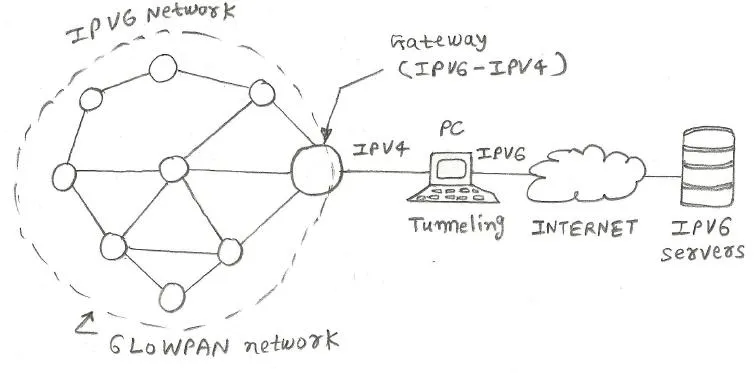 Fig.1
Fig.1
6LoWPAN Network Architecture
In a 6LoWPAN network, there are typically two types of nodes:
- End Node: An end node consists of a 6LoWPAN compliant radio, sensors, and a battery for power. It collects data from sensors and sends it to the gateway, effectively creating a mesh network.
- Gateway: The gateway receives information from the end nodes and forwards it to an IPv4/IPv6 server via an Ethernet interface. It also includes a 6LoWPAN compliant radio, an Ethernet interface, and a power source (often a battery).
Frequency Bands
6LoWPAN radios, compatible with Zigbee, operate in the 2.4 GHz, 868 MHz, and 915 MHz frequency bands.
Continue Learning IoT Protocols
- MQTT Architecture: Message Types, Format, Flow
- CoAP Protocol Architecture & Messages Exchanged between client & Server
- DDS Architecture & its protocol stack layers
- AMQP Architecture Components & Frames
- REST Protocol Vs. SoAP
- XMPP Protocol & Server-Client Interaction
- LWM2M : Key Advantages and Disadvantages
- 6LoWPAN Mesh Network & Protocol Stack
- RPL vs CORPL vs CARP: IoT Routing Protocol Comparison
- HTTP Vs. HTTPS : Key Comparison
- FTP Protocol Basics : key advantages & disadvantages
- Ping vs. Ping6: IPv4 and IPv6 Connectivity
- SFTP Vs. SCP : key Differences
- SSL Vs. SSH : Key Comparison
- MPTCP Protocol : Key Advantages & Disadvantages
- What is QUIC (Quick UDP Internet Connections)?
- TCP-IP Packet Format & its fields with example
Compare IoT Protocols
- MQTT Vs. DDS Protocol
- MQTT Vs. REST Protocol
- MQTT Vs. SMQTT
- CoAP Vs. MQTT : Key Differences
- CoAP Vs. HTTP : Comparison between them
- SFTP Vs. FTPS
- FTP Vs. HTTP : Key Differences between them
- FTP Vs. TFTP (Trivial File Transfer Protocol)
- FTP Vs. SMTP
- AMQP (Advanced Message Queuing Protocol) Vs. JMS(Java Message Service)
- TCP Vs. Multipath TCP (MPTCP)