
MQTT vs DDS: A Comparison of IoT Protocols
By RF Wireless Expert Team
Advertisement
This article compares MQTT and DDS (Data Distribution Service) protocols, both widely used in IoT. We’ll explore their differences in architecture, requirements, complexity, and other key aspects.
MQTT Protocol
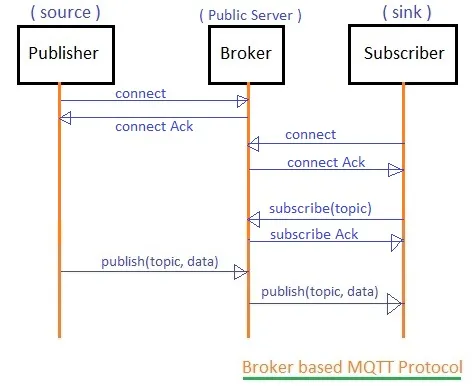
Figure 1: MQTT protocol architecture
Here are the key features of the MQTT protocol:
- It comprises three main components: publishers, a broker, and subscribers.
- It’s based on a publish/subscribe architecture.
- Publishers (e.g., sensors or IoT devices) send data or information updates to the broker based on specific topics.
- Subscribers (e.g., applications) register with the broker to receive updates related to particular topics or sensor data.
DDS Protocol
The following are key features of the DDS protocol:
- It’s a broker-less protocol primarily used for Machine-to-Machine (M2M) and IoT applications.
- It operates at the session layer of the OSI model.
- Instead of a broker, it employs data writers and data readers.
- Similar to MQTT, it follows a publish/subscribe model but without a central broker.
- It offers 23 Quality of Service (QoS) levels, encompassing security, priority, reliability, urgency, durability, and more.
DDS Protocol Workflow:
- A Publisher distributes the sensory data to be delivered.
- A Data Writer interacts with the publisher, managing any changes to be sent to subscribers.
- Data Readers receive the published data and deliver it to the corresponding subscribers.
- Subscribers must subscribe to specific topics, representing the sensory data they wish to receive.
MQTT vs. DDS: A Comparative Table
The following table provides a detailed comparison between MQTT and DDS protocols:
| Feature | MQTT | DDS |
|---|---|---|
| Full Form | Message Queue Telemetry Transport | Data Distribution Service |
| Architecture | Centralized; all communications route through the broker. | Decentralized; peer-to-peer communication. |
| Transport Layer | TCP | UDP |
| Admin Needed | Yes, a broker needs to be installed and clients configured with its address. | No, automatic discovery (plug and play), self-forming, self-healing. |
| Message Rate | Few messages per second per device. | Up to 10,000s of messages per second per device. |
| Service Interruptions | Tolerable. | Potentially calamitous. |
Continue Learning IoT Protocols
- MQTT Architecture: Message Types, Format, Flow
- CoAP Protocol Architecture & Messages Exchanged between client & Server
- DDS Architecture & its protocol stack layers
- AMQP Architecture Components & Frames
- REST Protocol Vs. SoAP
- XMPP Protocol & Server-Client Interaction
- LWM2M : Key Advantages and Disadvantages
- 6LoWPAN Mesh Network & Protocol Stack
- RPL vs CORPL vs CARP: IoT Routing Protocol Comparison
- HTTP Vs. HTTPS : Key Comparison
- FTP Protocol Basics : key advantages & disadvantages
- Ping vs. Ping6: IPv4 and IPv6 Connectivity
- SFTP Vs. SCP : key Differences
- SSL Vs. SSH : Key Comparison
- MPTCP Protocol : Key Advantages & Disadvantages
- What is QUIC (Quick UDP Internet Connections)?
- TCP-IP Packet Format & its fields with example
Compare IoT Protocols
- MQTT Vs. REST Protocol
- MQTT Vs. SMQTT
- CoAP Vs. MQTT : Key Differences
- CoAP Vs. HTTP : Comparison between them
- SFTP Vs. FTPS
- FTP Vs. HTTP : Key Differences between them
- FTP Vs. TFTP (Trivial File Transfer Protocol)
- FTP Vs. SMTP
- AMQP (Advanced Message Queuing Protocol) Vs. JMS(Java Message Service)
- TCP Vs. Multipath TCP (MPTCP)