
Zadoff-Chu Sequence in LTE
By RF Wireless Expert Team
Advertisement
The Zadoff-Chu (ZC) sequence, often referred to as a CAZAC (Constant Amplitude Zero Auto-Correlation) sequence, is a popular choice in LTE (Long-Term Evolution) technology. It’s favored for its beneficial properties that enhance signal quality and reduce interference.
The Zadoff-Chu sequence possesses the following key features:
- Small Time Variation: This contributes to good power amplification properties of the complex modulated signal in the LTE modem. Essentially, it helps maintain a consistent signal strength.
- Small Frequency Variation: This simplifies channel estimation at the receiver. Accurate channel estimation is crucial for proper signal demodulation.
- Low Cross-Correlation Property: This characteristic minimizes inter-cell interference. Lower interference means a cleaner signal and better performance, especially at cell edges.
Zadoff-Chu Sequence Definition
The Zadoff-Chu sequence is defined by the following mathematical equation:
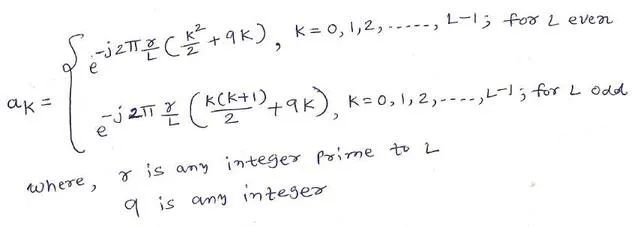
The equation mathematically represents the generation of the Zadoff-Chu sequence.
Zadoff-Chu Sequence Properties
The Zadoff-Chu sequence exhibits several important properties:
- Constant Amplitude: The signal strength remains consistent.
- Zero Circular Auto-Correlation: This means the signal is highly distinct from shifted versions of itself, crucial for timing and synchronization.
- Flat Frequency Domain Response: This even distribution of energy across frequencies simplifies signal processing.
- Low Circular Cross-Correlation: Two different Zadoff-Chu sequences have minimal interference with each other.
- Constant Amplitude (when L is prime): The constant amplitude characteristic is guaranteed if the length of the sequence, denoted by L, is a prime number.
LTE Physical Signals/Channels Using Zadoff-Chu Sequences
The Zadoff-Chu sequence is employed in several key physical signals and channels within LTE:
- P-SS (Primary Synchronization Signal): The Zadoff-Chu sequence is used for this signal, which is essential for cell search and initial synchronization.
- RS (Reference Signal): Used in both uplink and downlink, the Zadoff-Chu sequence provides a known signal for channel estimation.
- PUCCH (Physical Uplink Control Channel): The Zadoff-Chu sequence is used in the PUCCH, which carries control information from the user equipment (UE) to the base station (eNodeB).
Continue Learning 4G LTE
- 4G LTE Basics Tutorial
- 4G LTE Architecture: Network Elements and Interfaces
- LTE Frame Structure
- LTE Channel Types: Logical, Transport and Physical Channels
- LTE Protocol Stack: User Plane vs. Control Plane
- 4G LTE Physical Layer & its modules
- LTE Frequency Bands: FDD, TDD and E-UTRA Bands
- LTE Carrier Aggregation & its benefits
- 4G LTE Network Security
- LTE Cell Search Procedure
- LTE UE Uplink Network Entry : Random Access Procedure
- LTE Paging Procedure Mechanism and Call Flow
Explore More 4G LTE Frame Essentials
- LTE Terminologies
- LTE TDD and FDD Frame Types
- LTE PSS vs SSS : Key Differences
- LTE Reference Signals: RS, DMRS, and SRS
Explore More LTE Channels
- LTE PBCH Physical Broadcast Channel
- LTE PCFICH Channel : Physical Control Format Indicator Channel
- LTE PDCCH : Physical Downlink Control Channel
- LTE PDSCH Channel : Physical Downlink Shared Channel
- LTE PHICH: Physical Hybrid ARQ Indicator Channel
- LTE PMCH : Physical Multicast Channel
- LTE PRACH Channel: Physical Random Access Channel
- LTE PUCCH: Physical Uplink Control Channel
- LTE PUSCH: Physical Uplink Shared Channel
- LTE PSS vs SSS: Primary and Secondary Synchronization Signals
- LTE Reference Signals: RS, DMRS, and SRS