
LTE NB-IoT NPBCH: Function and Physical Layer Processing
Advertisement
This page describes the function and basics of the LTE NB-IoT NPBCH (Narrowband Physical Broadcast Channel) as per the LTE-NB IoT Standard. It covers LTE NB NPBCH Physical Layer Processing and NPBCH applications within the system.
Function of NPBCH
The NPBCH stands for NB-IoT Physical Broadcast Channel. It’s used to carry MIB (Master Information Block) information to the device in the downlink by the eNB (evolved NodeB, i.e., Base station). This helps the device to operate within the NB-IoT network.
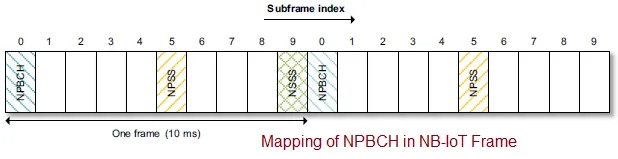
Location: As shown in the figure above, NPBCH uses a 640 ms TTI (Transmission Time Interval), but within that TTI, only subframe #0 is used in every radio frame.
The following table outlines key information about the NPBCH.
| NPBCH information | Value |
|---|---|
| Subframe | 0 |
| Subframe periodicity | 10 ms |
| Basic TTI | 640 ms |
| Subcarrier spacing | 15 KHz |
| Bandwidth | 180 KHz |
| Carrier | Anchor |
LTE NB NPBCH Physical Layer Processing
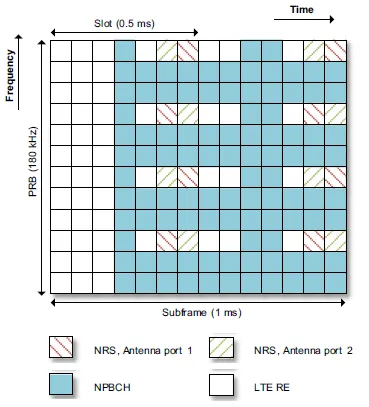
- As shown in the figure above, 100 REs (Resource Elements) are available for NPBCH in a subframe. NPBCH utilizes QPSK (Quadrature Phase Shift Keying) modulation. Therefore, 200 encoded bits can be carried in an NPBCH subframe.
- A TBS (Transport Block Size) of 34 bits, along with 16 bits of CRC (Cyclic Redundancy Check), results in 50 bits during NPBCH processing.
- These 50 bits are encoded by the LTE TBCC (Tail Biting Convolutional Code) and subsequently rate-matched to produce an output of 1600 encoded bits.
- These 1600 encoded bits are segmented into 8 CSBs (Code Subblocks), each with a size of 200 bits. Each of these CSBs is mapped to 100 QPSK symbols.
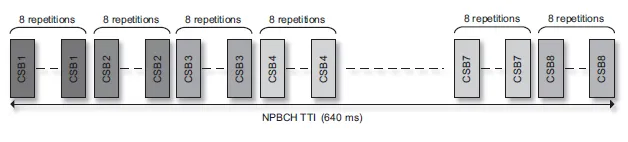
The figure above depicts the transmission of NPBCH CSBs. Symbol-level scrambling is applied to each CSB to provide robust protection against inter-cell interference.
- Reference: 3GPP 36 series Rel.13, 14, 15
Explore More LTE NB-IoT Channels
- LTE NB-IoT NPDCCH Channel
- LTE NB-IoT NPDSCH Channel
- LTE NB-IoT NPRACH Channel
- LTE NB-IoT NPSUCH Format 1-2
Continue Learning LTE NB-IoT Technology
- LTE NB-IoT Basics Tutorial
- LTE NB-IoT Network Architecture
- LTE NB-IoT Frame Structure
- LTE NB-IoT Protocol Stack
- LTE NB-IoT Channel Types
- LTE NB-IoT Frequency Bands
- LTE NB-IoT Advantages & Disadvantages
- LTE NB-IoT RACH Procedure
- LTE NB-IoT - PSM and EDRx Power Saving Modes
- LTE NB-IoT Cell Reselection Time
- LTE NB-IoT Coverage Enhancement Levels
- LTE NB-IoT Preamble Reference Signals
- LTE NB-IoT MIB-SIB Information Blocks
- LTE NB-IoT System Information Blocks