
What is XMPP Protocol: Advantages and Disadvantages
Advertisement
XMPP (Extensible Messaging and Presence Protocol) is an open communication protocol designed for instant messaging, presence information, and real time data exchange. Its advantages include decentralization, extensibility, and open standards, whereas its disadvantages include increased protocol complexity and relatively higher bandwidth overhead than some modern messaging protocols.
Key Features and applications of XMPP Protocol
XMPP stands for Extensible Messaging and Presence Protocol. It’s a client server architecture where an XMPP client communicates with an XMPP server using a TCP socket. It can also function over HTTP using a websocket implementation.
XMPP is an open protocol that streams XML elements to exchange messages in real time. Being asynchronous and XML-based, the protocol is defined in RFCs like RFC2778 and RFC2779 (general model for presence and instant messaging), RFC3920 (XMPP core), and RFC3921 (XMPP instant messaging).
XMPP’s features, including addressing, scalability, federation, and security, make it well-suited for IoT applications. It also uses a publish/subscribe mechanism for data sharing, similar to the MQTT protocol.
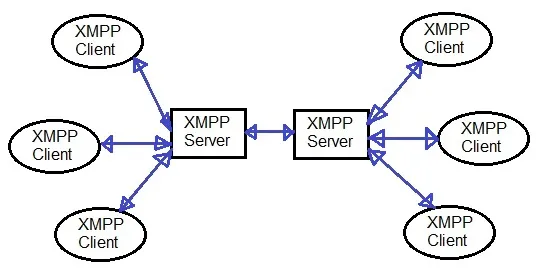
XMPP Client vs XMPP Server
The figure above shows a simplified XMPP architecture. It uses port 5222 for client-to-server communication and port 5269 for server to server communication.
XMPP is utilized in various applications, including:
- Instant messaging apps (e.g., Google Talk, WhatsApp)
- Presence status
- Message delivery
- Conferencing (multi-party chat)
- Roster management
- Voice and video calls
- Online gaming
- News websites
- VoIP apps
Benefits or advantages of XMPP Protocol
- Extensible: Customizable to individual user requirements.
- Messaging: Relies on short messages for quick communication between user and server.
- Presence: Reacts to the user’s presence and status.
- Open Protocol: An open platform that is constantly evolving.
- Secured: Uses TLS and SASL to provide a secure, end-to-end connection.
- Persistent Connection: Offers a persistent connection.
- Decentralized: No central XMPP servers are required.
- Interoperable: Allows servers with different architectures to communicate.
Drawbacks or disadvantages of XMPP Protocol
- No QoS: Lacks a Quality of Service (QoS) mechanism like the one used in MQTT.
- XML Overhead: Streaming XML has overhead due to its text-based communication compared to binary-based communication.
- Asynchronous XML: XML content is transported asynchronously.
- Server Overload: The server can be overloaded with presence and instant messaging traffic.
Summary
XMPP provides a secure, extensible, and standards based framework for real time messaging and communication across distributed networks.
Continue Learning IoT Protocols
- MQTT Architecture: Message Types, Format, Flow
- CoAP Protocol Architecture & Messages Exchanged between client & Server
- DDS Architecture & its protocol stack layers
- AMQP Architecture Components & Frames
- REST Protocol Vs. SoAP
- XMPP Protocol & Server-Client Interaction
- LWM2M : Key Advantages and Disadvantages
- 6LoWPAN Mesh Network & Protocol Stack
- RPL vs CORPL vs CARP: IoT Routing Protocol Comparison
- HTTP Vs. HTTPS : Key Comparison
- FTP Protocol Basics : key advantages & disadvantages
- Ping vs. Ping6: IPv4 and IPv6 Connectivity
- SFTP Vs. SCP : key Differences
- SSL Vs. SSH : Key Comparison
- MPTCP Protocol : Key Advantages & Disadvantages
- What is QUIC (Quick UDP Internet Connections)?
- TCP-IP Packet Format & its fields with example
Compare IoT Protocols
- MQTT Vs. DDS Protocol
- MQTT Vs. REST Protocol
- MQTT Vs. SMQTT
- CoAP Vs. MQTT : Key Differences
- CoAP Vs. HTTP : Comparison between them
- SFTP Vs. FTPS
- FTP Vs. HTTP : Key Differences between them
- FTP Vs. TFTP (Trivial File Transfer Protocol)
- FTP Vs. SMTP
- AMQP (Advanced Message Queuing Protocol) Vs. JMS(Java Message Service)
- TCP Vs. Multipath TCP (MPTCP)