
What is CoAP Protocol : Advantages and Disadvantages
Advertisement
CoAP (Constrained Application Protocol) is a lightweight web transfer protocol designed for IoT devices and resource constrained networks. It enables efficient machine to machine communication using minimal bandwidth and power. Advantages include low overhead and fast communication, while disadvantages include limited security features and reduced suitability for complex applications.
Introduction: The Constrained Application Protocol (CoAP) is a specialized web transfer protocol designed for use in resource constrained environments such as IoT (Internet of Things) devices and networks. Developed by the IETF, CoAP enables lightweight communication between devices with limited processing power, memory and bandwidth. It follows a RESTful architecture similar to HTTP but operates over UDP to reduce overhead and improve efficiency. CoAP is particularly useful in scenarios where low power consumption, simplicity and efficient communication are critical.
Key features of CoAP & its architecture
- CoAP operates on a client/server model, utilizing methods like GET, PUT, POST, and DELETE.
- CoAP supports both request/response and publish/subscribe communication patterns.
- It can be bound to UDP, TCP, and SMS.
- Defined in RFC 7252, CoAP is a highly efficient RESTful protocol.
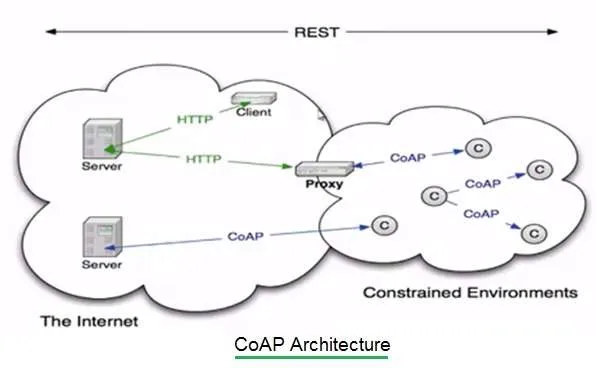
- As illustrated in the figure above, CoAP integrates both HTTP and CoAP clients.
- A proxy device bridges the gap between the constrained network and the standard HTTP-based internet.
- CoAP uses both asynchronous and synchronous message types.
- The header size is only 4 bytes.
- For more detailed information, refer to articles on CoAP Protocol architecture, differences between CoAP vs. HTTP, and CoAP vs. MQTT.
Advantages of CoAP Protocol
- Simplicity and Low Overhead: CoAP is a simple protocol with minimal overhead due to its operation over UDP.
- Power Efficiency: It allows for short wake-up times and long sleep states, contributing to extended battery life for IoT and M2M devices.
- Secure Communication: CoAP utilizes IPSEC or DTLS for secure communication.
- Flexible Communication: Synchronous communication is not mandatory in CoAP.
- Low Latency: It boasts lower latency compared to HTTP.
- Low Power Consumption: CoAP consumes less power than HTTP.
- Reliable Communication: Through the use of ACK messages, CoAP achieves reliability similar to HTTP while avoiding unnecessary retransmissions.
- Ideal for Home Networks: CoAP is a suitable protocol choice for home communication networks, finding applications in information appliances, communication equipment, and control equipment in smart homes.
Disadvantages of CoAP Protocol
- Unreliability (UDP-Based): Due to its reliance on UDP, CoAP is inherently unreliable. Messages may arrive out of order or get lost during transmission. To mitigate this, CoAP implements a stop-and-wait mechanism with exponential backoff retransmission and duplicate detection.
- Increased Processing Time: Acknowledging each received message increases processing time. Furthermore, CoAP does not verify if the received message has been decoded correctly.
- Security Overhead: While it can be secured using DTLS, CoAP is inherently unencrypted (like MQTT). Implementing DTLS adds implementation overhead.
- NAT Traversal Issues: CoAP can face communication challenges for devices behind Network Address Translation (NAT).
Summary
CoAP is a lightweight IoT communication protocol optimized for constrained devices. Advantages include low bandwidth usage and efficiency, while disadvantages include security and scalability limitations.
Continue Learning IoT Protocols
- MQTT Architecture: Message Types, Format, Flow
- CoAP Protocol Architecture & Messages Exchanged between client & Server
- DDS Architecture & its protocol stack layers
- AMQP Architecture Components & Frames
- REST Protocol Vs. SoAP
- XMPP Protocol & Server-Client Interaction
- LWM2M : Key Advantages and Disadvantages
- 6LoWPAN Mesh Network & Protocol Stack
- RPL vs CORPL vs CARP: IoT Routing Protocol Comparison
- HTTP Vs. HTTPS : Key Comparison
- FTP Protocol Basics : key advantages & disadvantages
- Ping vs. Ping6: IPv4 and IPv6 Connectivity
- SFTP Vs. SCP : key Differences
- SSL Vs. SSH : Key Comparison
- MPTCP Protocol : Key Advantages & Disadvantages
- What is QUIC (Quick UDP Internet Connections)?
- TCP-IP Packet Format & its fields with example
Compare IoT Protocols
- MQTT Vs. DDS Protocol
- MQTT Vs. REST Protocol
- MQTT Vs. SMQTT
- CoAP Vs. MQTT : Key Differences
- CoAP Vs. HTTP : Comparison between them
- SFTP Vs. FTPS
- FTP Vs. HTTP : Key Differences between them
- FTP Vs. TFTP (Trivial File Transfer Protocol)
- FTP Vs. SMTP
- AMQP (Advanced Message Queuing Protocol) Vs. JMS(Java Message Service)
- TCP Vs. Multipath TCP (MPTCP)