
VCO Tuning Constant and Tuning Methods Explained
Advertisement
This page explains the VCO tuning constant (KVCO) and different VCO tuning methods. It also includes links to pages covering VCO basics and VCO types.
A VCO (Voltage-Controlled Oscillator) is an oscillator whose frequency can be varied by applying a voltage or current.
VCO Tuning Constant (KVCO)
The VCO tuning constant, often denoted as KVCO, specifies how much the VCO’s frequency changes per unit change in voltage or current. It is typically measured in Hz/Volt or Hz/Ampere. This constant is also known as the VCO gain.
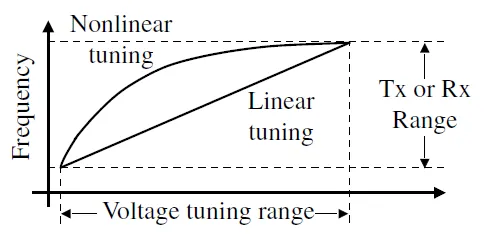
The figure illustrates the VCO tuning constant.
For example, if a VCO’s tuning range is 2.4 GHz to 2.483 GHz (as per the Bluetooth standard) and the tuning voltage range is 2.7 Volts, then the tuning constant can be calculated as follows:
It’s worth noting that the term “tuning constant” can be a bit misleading. The value becomes larger as the tuning range increases.
VCO Types and Tuning Methods
Continue Learning Voltage Controlled Oscillators (VCO)
Deep dives into how voltage controlled oscillators generate frequencies, how they are tuned, and how they integrate with PLLs.
- Voltage Controlled Oscillators (VCOs) Overview
- VCO Basics (Voltage Controlled Oscillators)
- Difference Between VCO and PLL
- NCO vs VCO: Understanding the Differences
- VCO vs VCXO Differences
- MAX2871 Wideband PLL/VCO IC: Pin Diagram and Applications
Explore Phase-Locked Loops (PLL) & IC Applications
Understand the core mechanics of Phase Locked Loops and explore application notes for popular PLL chips used in RF design.